
Paper Trail
ICE Operational Crisis: Fatalities and Policy Reversals
Following fatal shootings by agents, ICE briefly suspended vehicle stops before a presidential intervention reinstated the practice, sparking national debate over vetting and tactics.
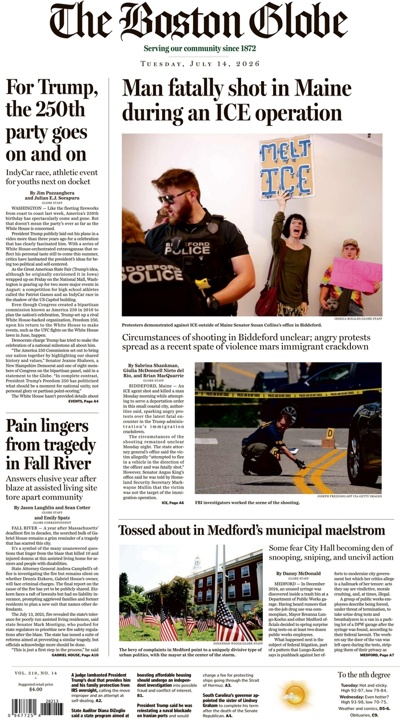
Boston Globe
“Man fatally shot in Maine during an ICE operation”
— Boston Globe
Local authorities and AGs launch investigations into fatal ICE shootings in Maine and Texas.
On the first day, the story is treated as a matter of local accountability. The Washington_Post and Boston_Globe focus on the Maine Attorney General's investigation, emphasizing the 'deadly' nature of the encounter. The Houston_Chronicle highlights the 'lack of transparency' from federal agents.
At this stage, the papers are acting as watchdogs for local victims, with little indication that this will become a national policy flashpoint. The focus is on the specific 'shooting probe' and the immediate community shock.
Notable angles
Houston Chronicle — Focuses on the DA's 'unacceptable' label for the lack of transparency, framing it as a local vs. federal power struggle.
Left out: No mention of the specific internal ICE protocols for vehicle stops that were allegedly violated.
Also covered by 3 papers — click to enlarge
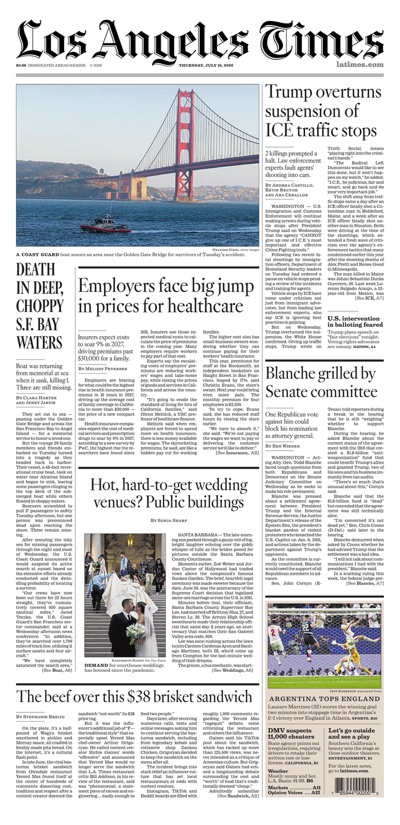
Los Angeles Times
“Trump overturns suspension of ICE traffic stops”
— Los Angeles Times
President Trump overrides the temporary suspension of traffic stops despite expert warnings.
This is the pivot point where the story becomes a national political drama. The Los_Angeles_Times leads with the expert criticism of 'shooting into cars,' framing the President's reversal as a rejection of basic safety standards.
The coverage across the Chicago_Tribune and Boston_Globe begins to humanize the victims—mentioning 'legal status' and 'witness accounts'—which serves to heighten the editorial tension against the administration's 'resume stops' order. The papers are collectively highlighting a widening gap between executive directives and professional law enforcement consensus.
Notable angles
Los Angeles Times — Explicitly cites 'law enforcement experts' who criticize the practice of shooting into vehicles as inherently unsafe.
Minnesota Star Tribune — Reports that the victim in Maine had 'legal status,' directly challenging the 'criminal alien' narrative often used to justify such stops.
Where papers diverged
The Washington_Post adopts a more neutral 'Halt is lifted' headline, while the Los_Angeles_Times uses more active, critical language regarding the 'overturning' of safety measures.
Left out: None of the papers provided the specific body camera footage or explained why it was unavailable.
Also covered by 7 papers — click to enlarge

Washington Post
“ICE officer’s troubled past renews vetting concerns”
— Washington Post
The focus shifts to systemic failures in ICE vetting and the diversion of FEMA resources to support raids.
The thread concludes with a 'deep dive' into agency rot. The Washington_Post’s focus on the 'troubled past' of specific officers suggests the problem is not just policy, but personnel vetting. This is a significant escalation from the 'accidental shooting' frame of day one.
The Arizona_Republic adds a new layer of scandal by reporting on the diversion of FEMA staff, suggesting a 'whole of government' push for immigration enforcement that compromises other agencies. The narrative has moved from a single tragic event to a broader indictment of the agency's operational integrity and the political pressure placed upon it.
Notable angles
Arizona Republic — Reveals a House report showing DHS diverted FEMA staff to assist in ICE raids, linking the story to disaster preparedness.
Where papers diverged
The New_York_Times focuses on the FBI's refusal to investigate the clashes, highlighting an internal breakdown in federal oversight that other papers missed.
Left out: Lack of response from the DHS Secretary regarding the diversion of FEMA funds.
Also covered by 3 papers — click to enlarge
“Initial focus on local investigative transparency shifted to a national critique of the agency's vetting processes and the President's direct command to resume high-risk tactics.”
Narrative Arc
The story began as a localized tragedy in Maine and Texas, quickly ballooning into a federal policy crisis. The narrative moved from the 'pause' in operations to a direct confrontation between the White House and law enforcement experts over the safety of shooting into moving vehicles.
Dropped It
Picked It Up
How Each Paper Evolved
Transitioned from reporting on local investigations to uncovering systemic vetting failures within the agency.
Maintained a focus on the local impact in Texas, from the initial shooting to the viewing of the victim (Salgado).
Shifted from the Maine shooting to broader 'expert' criticism of ICE tactics and the personal history of the agents involved.