
Paper Trail
Direct Military Conflict and Fragile Ceasefire Negotiations
A long-standing diplomatic crisis between the US and Iran collapsed into direct missile exchanges between Iran and Israel before reaching a tentative pause.
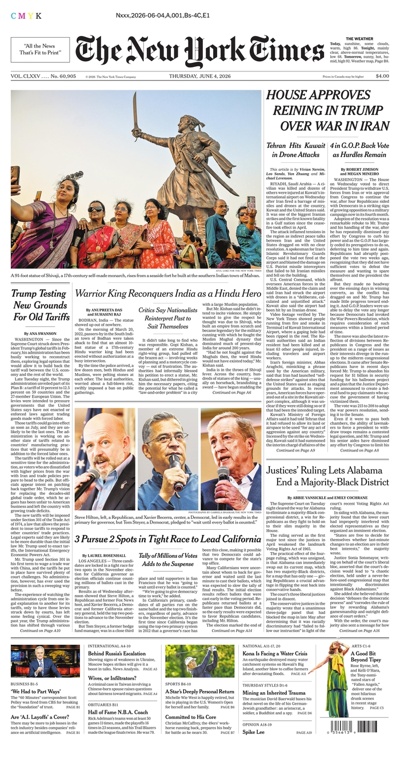
New York Times
“HOUSE APPROVES REINING IN TRUMP OVER WAR IN IRAN”
— New York Times
Constitutional confrontation as the House attempts to rein in executive military authority.
The New_York_Times and Wall_Street_Journal elevated the House resolution to a major constitutional flashpoint, framing it as a direct rebuke of the administration's 'strategy'—or lack thereof. This was a notable shift from the previous day's focus on individual policy appointments, suggesting that the legislative branch sensed an imminent escalation that the executive branch was not communicating.
While the national papers focused on the power struggle in D.C., the Philadelphia_Inquirer provided critical context by noting that prewar warnings regarding the Strait of Hormuz had been systematically ignored. This reveals a press corps that is beginning to look backward to assign blame even as the current crisis accelerates.
Notable angles
Philadelphia Inquirer — Focuses on the historical failure of intelligence warnings regarding the Strait of Hormuz.
Arizona Republic — Reports a claim from the President that Iran has already agreed to 'no nukes' for the time being.
Where papers diverged
There was a clear divide between the 'constitutional' framing of the New_York_Times and the more skeptical, regional framing of the Arizona_Republic, which highlighted the President's own claims of a nuclear deal that other papers largely ignored or buried.
Left out: No paper provided a clear roadmap for how the House resolution would survive a Senate vote or a Presidential veto.
Also covered by 5 papers — click to enlarge
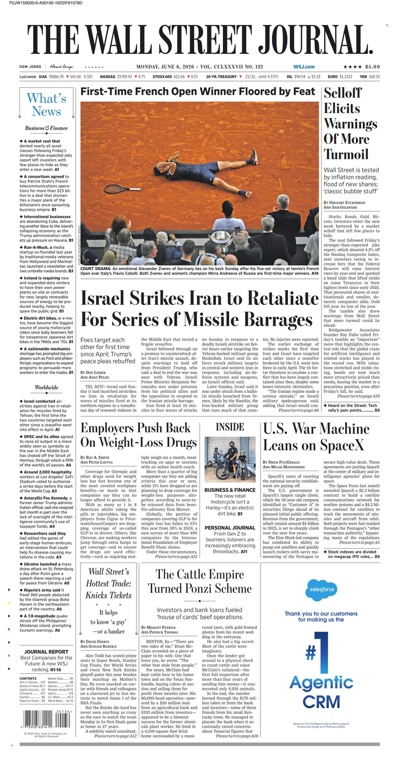
Wall Street Journal
“Israel Strikes Iran to Retaliate For Series of Missile Barrages”
— Wall Street Journal
Direct military escalation as Iran and Israel trade missile strikes.
The tone shifted from 'political tension' to 'kinetic warfare' overnight. The New_York_Times used its most aggressive headline of the week, focusing on the breakdown of the ceasefire. The Wall_Street_Journal, however, took a more strategic view, framing the strikes as a failure of international diplomacy and a new, more dangerous phase of regional instability.
The Washington_Post was particularly focused on the threat these strikes posed to the broader peace process, suggesting that the 'trade' of attacks was a calculated move by both sides to reset the terms of negotiation. This collective coverage reveals a media landscape that had largely moved past the 'war powers' debate of day 4 and was now reacting to a fait accompli on the ground.
Notable angles
Washington Post — Frames the strikes specifically as a reciprocal threat to ongoing peace negotiations.
Wall Street Journal — Highlights the failure of diplomatic intervention as the primary cause of the escalation.
Where papers diverged
While most papers focused on the strikes themselves, the Philadelphia_Inquirer chose to lead with the President's defensive rhetoric regarding his campaign promises, highlighting a disconnect between the military reality and the domestic political spin.
Left out: Detailed technical data on missile types or verified casualty figures were absent across all front pages.
Also covered by 5 papers — click to enlarge
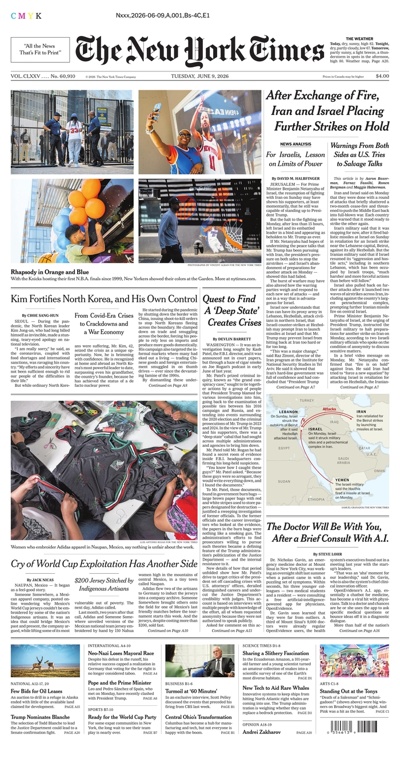
New York Times
“After Exchange of Fire, Iran and Israel Placing Further Strikes on Hold”
— New York Times
A fragile pause in hostilities as international mediation begins.
The final day of the window shows a rare moment of editorial consensus on the 'pause,' but the underlying anxiety remains high. The New_York_Times and Minnesota_Star_Tribune both emphasized the fragility of this window, suggesting that the 'hold' on strikes is a temporary tactical choice rather than a diplomatic breakthrough.
The Washington_Post provided the most insightful political context, reporting on the internal friction between Netanyahu and the U.S. administration. This suggests that while the missiles have stopped flying, the diplomatic war is intensifying. The Arizona_Republic's mention of Pakistan as a mediator adds a layer of regional complexity that the more Euro-centric or US-centric papers missed, showing how the story is expanding into a global geopolitical event.
Notable angles
Washington Post — Focuses on the domestic Israeli pressure on Netanyahu to resist U.S. diplomatic interference.
Arizona Republic — Identifies Pakistan as a key mediator in the ceasefire talks.
Where papers diverged
The Wall_Street_Journal diverged from the 'pause' narrative to analyze the long-term shift in Iran's goals, suggesting that the attack itself changed the regional status quo regardless of the current ceasefire.
Left out: Specific demands from either side for a permanent ceasefire remain undisclosed in the press.
Also covered by 9 papers — click to enlarge
“Initial domestic legislative focus on war powers gave way to urgent military reporting of strikes, eventually settling into skeptical diplomatic analysis of a fragile ceasefire.”
Narrative Arc
The week began with legislative attempts in the US to restrain presidential war powers, which were quickly overshadowed by a historic direct military exchange between Iran and Israel. By the end of the window, the narrative shifted from active combat to a high-stakes diplomatic waiting game as international mediators sought to stabilize a fragile pause in hostilities.
Picked It Up
How Each Paper Evolved
Shifted from constitutional oversight to reporting active warfare, then to cautious diplomatic optimism.
Maintained a focus on the intersection of military action and diplomatic negotiation pressure.
Consistently framed the conflict through the lens of failed diplomacy and strategic shifts in regional power.