
Paper Trail
Iran-Israel Military Escalation and US Intervention
A week of direct missile exchanges between Iran and Israel evolved into a US military intervention and subsequent erratic diplomatic pivot.
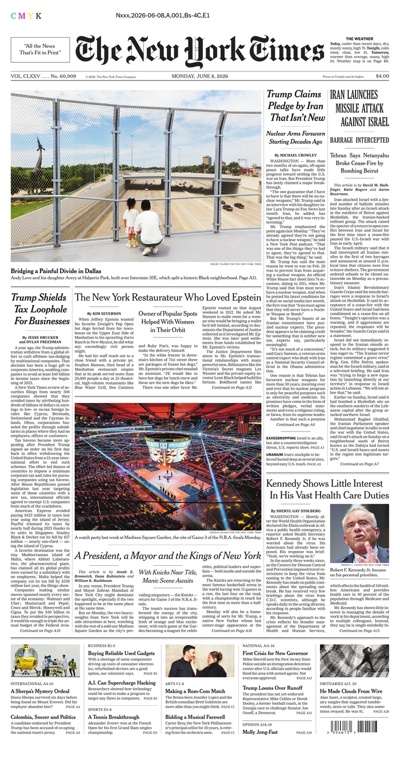
New York Times
“IRAN LAUNCHES MISSILE ATTACK AGAINST ISRAEL”
— New York Times
Direct military confrontation between regional powers marks a collapse of previous diplomatic efforts.
The front pages on June 8th were dominated by a sense of historical rupture. The New_York_Times and Wall_Street_Journal both led with the direct nature of the strikes, moving away from the 'proxy war' language that has defined the region for decades. This was presented not as a skirmish, but as a systemic failure of the international order.
While the Washington_Post attempted to maintain a focus on the 'trade' of attacks—implying a reciprocal logic—the Los_Angeles_Times and Houston_Chronicle highlighted the suddenness of the escalation. The collective coverage revealed a media landscape caught off-guard, focusing heavily on the immediate kinetic actions rather than the long-term strategic fallout.
Notable angles
Washington Post — Framed the escalation specifically as a threat to ongoing, fragile peace negotiations rather than just a military event.
Where papers diverged
The Wall_Street_Journal focused heavily on the failure of diplomatic intervention as a strategic vacuum, whereas the New_York_Times prioritized the tactical sequence of the retaliatory strikes.
Left out: Detailed technical analysis of missile defense success rates or specific casualty figures was absent.
Also covered by 5 papers — click to enlarge
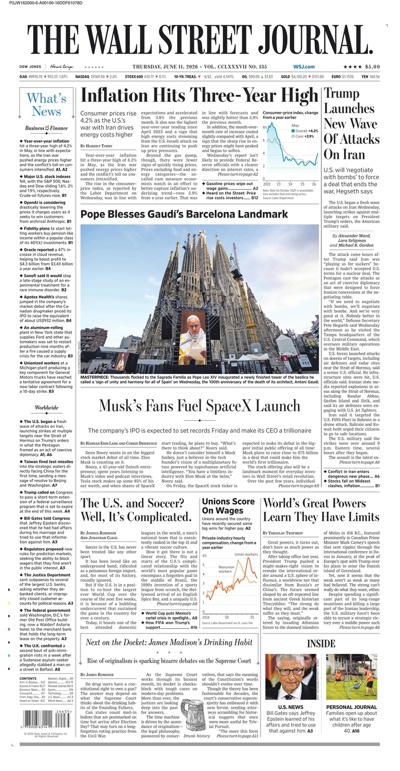
Wall Street Journal
“Inflation Hits Three-Year High”
— Wall Street Journal
The cost of war moves from the battlefield to the American household as inflation spikes.
This day marked a significant pivot where geopolitics met the kitchen table. The Wall_Street_Journal and Philadelphia_Inquirer explicitly linked the intensification of the Iran conflict to a three-year high in inflation. This framing transformed a 'foreign' story into a primary domestic concern, with papers like the Minnesota_Star_Tribune using the war as a direct explanatory variable for economic pain.
The tone shifted from military alarm to economic dread. The New_York_Times highlighted Trump's 'frustration' with talks, signaling that the administration was moving toward 'coercive diplomacy.' This suggests an editorial consensus that the diplomatic window was not just closing, but being actively slammed shut by the White House.
Notable angles
Arizona Republic — Focused on the specific 'pay' rhetoric used by Trump, emphasizing the punitive nature of the administration's stance.
Where papers diverged
There was a clear split between papers focusing on the strategic 'truce on the brink' (Washington_Post) and those focusing on the 'Consumer Price Index' impact (Wall_Street_Journal).
Left out: The perspective or internal political pressures within the Iranian government were entirely omitted.
Also covered by 7 papers — click to enlarge
“Initial reporting on regional war-footing transitioned into a narrative of domestic economic consequence before settling on administrative unpredictability by day 7.”
Narrative Arc
The narrative began with high-alarm reporting on unprecedented direct missile exchanges, which quickly shifted to the failure of international mediation. By mid-week, the focus moved to US military retaliation for a downed helicopter and the resulting domestic economic shock, before ending on a skeptical analysis of the Trump administration's sudden diplomatic reversal.
Picked It Up
How Each Paper Evolved
Moved from reporting military facts to analyzing the administration's 'pivoting' and inconsistency.
Consistently tied the conflict to global economic stability and domestic inflation metrics.