
Paper Trail
The Resignation of Keir Starmer and Labour Leadership Transition
Internal Labour Party pressure culminated in the resignation of Prime Minister Keir Starmer and the rise of Andy Burnham.
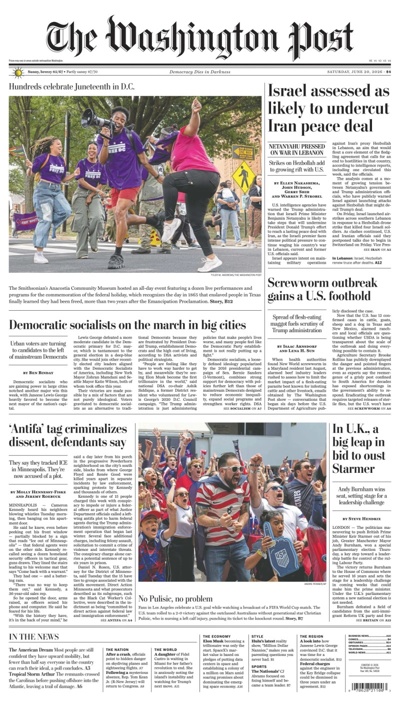
Washington Post
“In U.K., a big leap in bid to oust Starmer”
— Washington Post
Early reports of a coordinated effort within the Labour Party to remove Starmer.
The Washington_Post was the first major US outlet to elevate this from a domestic UK issue to a front-page concern, framing it as a 'big leap' in the effort to oust the PM. This early coverage focused on the mechanics of the challenge rather than the ideological split.
At this stage, other US papers ignored the story, suggesting a higher threshold for UK political news unless a definitive 'fall' is imminent. The Post's decision to run this indicated a high level of confidence in their London bureau's sourcing regarding the severity of the revolt.
Notable angles
Washington Post — Sole US paper identifying the 'big leap' in the ouster attempt before the official resignation.
Left out: The specific identity of Andy Burnham as the primary successor was not yet the dominant headline focus.
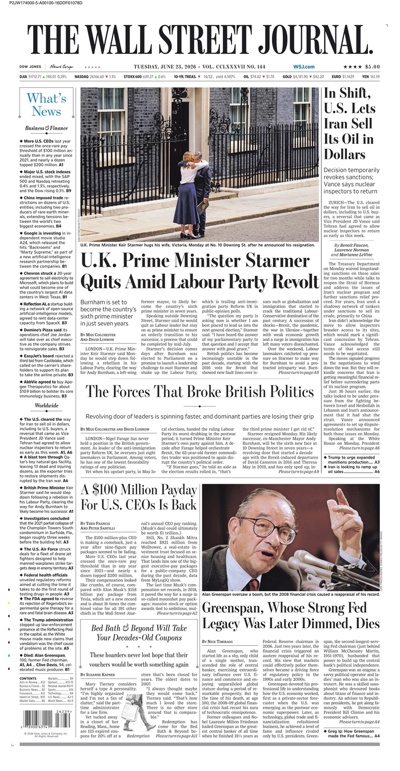
Wall Street Journal
“U.K. Prime Minister Starmer Quits Amid Labour Party Revolt”
— Wall Street Journal
Formal resignation of Starmer amid a 'Labour Party Revolt' and the arrival of his rivals.
The tone across the US press was one of clinical observation of British political volatility. The Wall_Street_Journal used the word 'Revolt' to describe the internal party dynamics, while the New_York_Times adopted a more literary tone, describing Starmer as exiting with his 'rival at the gates.'
This collective coverage reveals a US media consensus that the Starmer era was defined by its brevity and the speed of its collapse. The Philadelphia_Inquirer's framing—asking how he went from a 'landslide to resignation in 2 years'—provided the most direct historical context, highlighting the extreme compression of political cycles in the 2020s.
Notable angles
Philadelphia Inquirer — Analytical focus on the rapid erosion of a historic electoral mandate.
Where papers diverged
The Los_Angeles_Times was notably less 'alarmed' (score 3) than the national papers, treating it as a standard political transition rather than a crisis of governance.
Left out: Detailed analysis of the specific policy failures that led to the revolt was largely missing in favor of 'horse race' leadership coverage.
Also covered by 6 papers — click to enlarge
“Speculative internal 'revolt' reporting solidified into a definitive leadership transition by the final day of the window.”
Narrative Arc
The story simmered as a secondary international item on June 20 before exploding into a global lead on June 23. Coverage evolved from speculative reports of a 'bid to oust' Starmer to a definitive post-mortem on his two-year tenure following his official resignation.
Picked It Up
How Each Paper Evolved
Maintained a consistent focus on the internal party mechanics and specific triggers for the resignation.