
Paper Trail
The Resignation of Prime Minister Keir Starmer
British Prime Minister Keir Starmer resigned following a rapid collapse of internal party support, leading to a transition toward Andy Burnham.
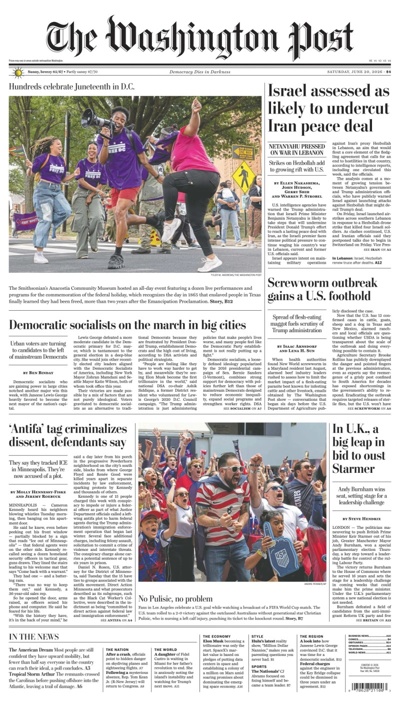
Washington Post
“In U.K., a big leap in bid to oust Starmer”
— Washington Post
Initial reports of a significant internal Labour Party move to remove the Prime Minister.
The Washington_Post was the early outlier in the US market, identifying the 'big leap' in the bid to oust Starmer. This early coverage focused on the mechanics of the party revolt rather than the personal failure of the leader, setting a tone of clinical political analysis.
This early inclusion suggests the Post's editorial desk viewed the UK's internal stability as a critical component of the broader Western alliance, particularly as the US-Iran crisis deepened simultaneously.
Notable angles
Washington Post — Framing the event as a 'big leap' in a coordinated effort rather than a surprise resignation.
Left out: The specific identity of the 'successor' was not yet the primary focus.
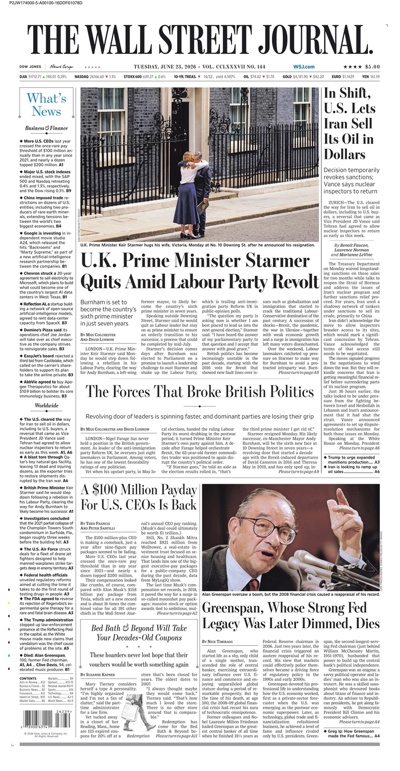
Wall Street Journal
“U.K. Prime Minister Starmer Quits Amid Labour Party Revolt”
— Wall Street Journal
Formal resignation of the Prime Minister amid a 'Labour Party Revolt.'
The resignation was treated as a fait accompli across the US press. The Wall_Street_Journal used the word 'Quits' to emphasize the abruptness, while the New_York_Times focused on the 'Rival at the Gates,' signaling a shift toward the future leadership of Andy Burnham.
The collective coverage reveals a US media fascination with the perceived fragility of the British parliamentary system. The Philadelphia_Inquirer's headline—asking how Starmer went from a 'landslide to resignation in 2 years'—encapsulated the dominant narrative of a rapid and total political collapse.
Notable angles
Philadelphia Inquirer — Focusing on the historical irony of the short timeline between Starmer's landslide victory and his exit.
Where papers diverged
The New_York_Times focused on the successor, while the Wall_Street_Journal focused on the internal party mechanics of the revolt.
Left out: Analysis of the specific policy failures that led to the revolt was thin compared to the focus on party optics.
Also covered by 6 papers — click to enlarge
“Speculative reporting on party revolts turned into definitive historical assessments of a failed premiership by day 5.”
Narrative Arc
The story broke as a 'bid to oust' on day 2 and accelerated into a full resignation by day 5. US coverage focused heavily on the speed of the collapse, framing it as a symptom of broader UK political instability and 'leadership turnover.'
Picked It Up
How Each Paper Evolved
Moved from tracking the 'bid to oust' to reporting the final resignation and its impact on UK-US relations.