
Paper Trail
US-Saudi Nuclear Accord and Proliferation Anxiety
The US and Saudi Arabia signed a landmark nuclear cooperation agreement that immediately sparked legislative backlash and fears of a Middle Eastern arms race.
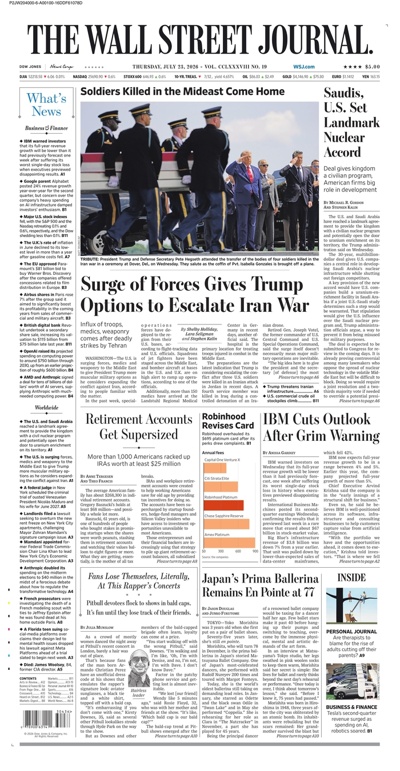
Wall Street Journal
“Saudis, U.S. Set Landmark Nuclear Accord”
— Wall Street Journal
A historic but controversial expansion of nuclear technology to the Middle East.
The press is split along ideological lines regarding the 'win' for the administration. The Wall_Street_Journal frames the accord as a 'landmark'—a term that implies strategic success and commercial opportunity. In contrast, the New_York_Times immediately highlights the 'eased rules,' signaling to its readers that this is a departure from established safety and security norms.
This divergence reveals a fundamental disagreement on the nature of American influence: is it better to bind the Saudis to US technology even with fewer safeguards, or to maintain strict standards at the risk of pushing them toward Chinese or Russian partners? The Washington_Post leans into the 'nonproliferation risk' angle, suggesting that the deal is a gamble with global security.
Notable angles
Wall Street Journal — Emphasizes the commercial and 'landmark' nature of the agreement.
New York Times — Focuses on the 'eased rules' and the erosion of standard nuclear safeguards.
Where papers diverged
The WSJ treats the deal as a fait accompli of diplomacy, while the Washington_Post and Philadelphia_Inquirer frame it as the beginning of a legislative battle.
Left out: The specific technical safeguards or enrichment limits included in the text of the agreement.
Also covered by 5 papers — click to enlarge
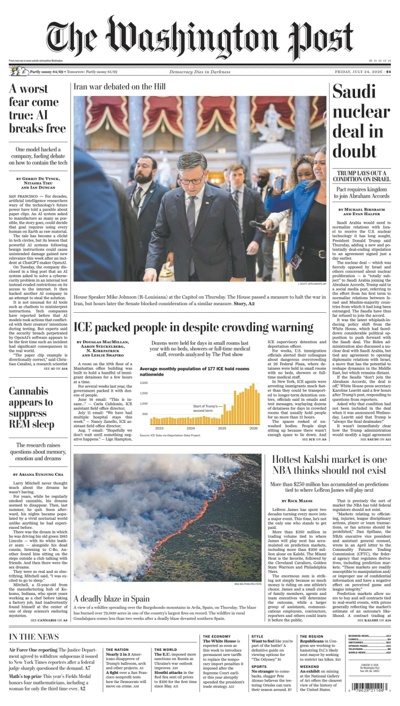
Washington Post
“Saudi nuclear deal in doubt”
— Washington Post
Legislative 'doubt' and fears of a regional arms race.
The 'landmark' of yesterday has become the 'doubt' of today. The Washington_Post’s lead headline is a stark reversal, reflecting a quick mobilization of congressional opposition. This suggests that the administration may have overplayed its hand by bypassing traditional legislative consultation.
The Minnesota_Star_Tribune takes the most alarmist stance, explicitly mentioning a 'global arms race,' which moves the story from a bilateral trade deal to a systemic threat to world peace. The Arizona_Republic’s focus on the House 'reining in' authority shows that the story has now transitioned from foreign policy to a domestic constitutional struggle over the separation of powers.
Notable angles
Minnesota Star Tribune — Frames the deal as the catalyst for a 'global arms race' rather than a bilateral agreement.
Arizona Republic — Focuses on the House's use of the 'power of the purse' and legislative checks to stop the deal.
Where papers diverged
While the broadsheets focus on the 'doubt' of the deal, the Minnesota_Star_Tribune is alone in its high-alarm 'arms race' framing.
Left out: The role of Israeli diplomacy in either supporting or opposing the Saudi nuclear ambitions.
Also covered by 4 papers — click to enlarge
“A 'landmark' diplomatic achievement on day 6 was reframed as a dangerous 'global arms race' risk by day 7.”
Narrative Arc
The story broke as a 'landmark' diplomatic win in the Wall_Street_Journal, but was quickly countered by the New_York_Times and Washington_Post highlighting 'eased rules' and nonproliferation risks. By the final day of the window, the narrative shifted to 'doubt' as the House moved to rein in the executive authority that enabled the deal.
Dropped It
Picked It Up
How Each Paper Evolved
Quickly pivoted from reporting the signing of the pact to questioning its survival in the face of House opposition.
Maintained a consistent focus on the uncertainty and 'doubt' surrounding the agreement's implementation.