
Paper Trail
Supreme Court Reshaping Executive and Social Policy
A week of landmark Supreme Court rulings that expanded presidential power, upheld birthright citizenship, and restricted transgender participation in sports.
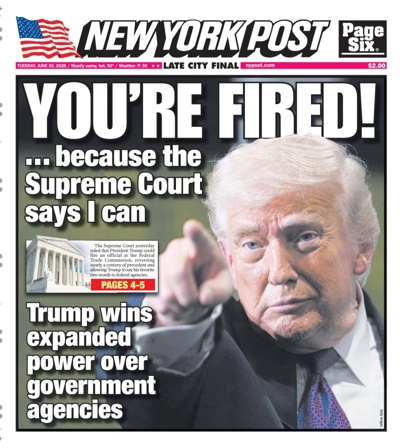
New York Post
“YOU’RE FIRED! ... because the Supreme Court says I can”
— New York Post
The expansion of presidential authority to fire agency heads, with a notable carve-out for the Federal Reserve.
This day marked a significant escalation in the 'imperial presidency' narrative. The Washington_Post and New_York_Times treated the ruling as a fundamental shift in the balance of power, using terms like 'broaden sway' and 'expands power.' The coverage revealed a deep anxiety about the erosion of independent regulatory bodies.
Interestingly, the Wall_Street_Journal and Houston_Chronicle chose to lead with the 'exception'—the fact that the Federal Reserve chief remained protected. This suggests a pro-market editorial priority, where the independence of the Fed is viewed as more critical than the independence of other federal agencies. The New_York_Post, predictably, reduced the complex constitutional ruling to a catchphrase: 'YOU’RE FIRED!'
Notable angles
Wall Street Journal — Prioritized the Federal Reserve's exemption over the broader expansion of presidential power.
New York Post — Framed a complex legal ruling through the lens of the President's former reality TV persona.
Where papers diverged
A sharp divide between papers focusing on the 'win' for executive power (NYT, WP) and those focusing on the 'protection' of the Fed (WSJ, Houston_Chronicle).
Left out: Detailed analysis of the dissenting justices' specific legal reasoning.
Also covered by 10 papers — click to enlarge
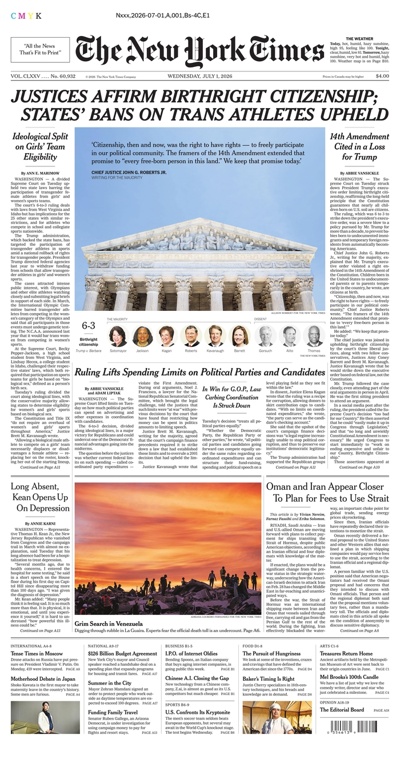
New York Times
“JUSTICES AFFIRM BIRTHRIGHT CITIZENSHIP; STATES’ BANS ON TRANS ATHLETES UPHELD”
— New York Times
A dual-track day of rulings: a victory for civil rights (birthright citizenship) and a victory for social conservatives (transgender sports bans).
The coverage on July 1st was a study in editorial selection. Most broadsheets (NYT, WSJ, LA_Times) led with the birthright citizenship ruling, framing it as a definitive check on the President's attempt to redefine the 14th Amendment. This was presented as a 'momentous' and 'striking' decision that preserved a core tenet of American identity.
In contrast, the New_York_Post relegated the citizenship ruling to a secondary item, instead splashing 'NO BOYS ALLOWED' across its front page to celebrate the ruling on transgender athletes. This divergence highlights how the same Court session can be packaged as either a constitutional safeguard or a cultural victory, depending on the paper's target demographic. The Washington_Post specifically framed the citizenship ruling as a 'strike' against a Trump order, emphasizing the personal defeat for the executive.
Notable angles
New York Post — Used exclusionary, colloquial language to focus exclusively on the transgender sports ruling.
Washington Post — Framed the citizenship ruling specifically as a personal rebuke to a 'Trump order'.
Where papers diverged
The New_York_Post stood in stark contrast to the rest of the pack by ignoring the citizenship ruling as its lead, focusing instead on the cultural grievance of transgender sports.
Left out: Analysis of how these rulings might influence the upcoming midterm elections.
Also covered by 12 papers — click to enlarge
“Initial focus on executive 'clout' and agency control shifted to a more nuanced debate over citizenship and social identity by the week's end.”
Narrative Arc
The week began with the Court empowering the executive branch on immigration and agency management, creating a narrative of 'Trump wins.' However, the mid-week upholding of birthright citizenship provided a surprising counter-narrative of judicial independence before the term ended with a return to social-conservative victories regarding transgender athletes.
Dropped It
Picked It Up
How Each Paper Evolved
Consistent focus on the expansion and subsequent checking of executive power.
Focused on the legal mechanics and the specific implications for financial/regulatory independence.
Shifted from celebrating executive power to celebrating social-conservative judicial outcomes.