
Paper Trail
Supreme Court Redefines Executive Power and Civil Rights
A series of landmark Supreme Court rulings significantly expanded presidential authority over federal agencies while delivering mixed verdicts on birthright citizenship and transgender participation in sports.
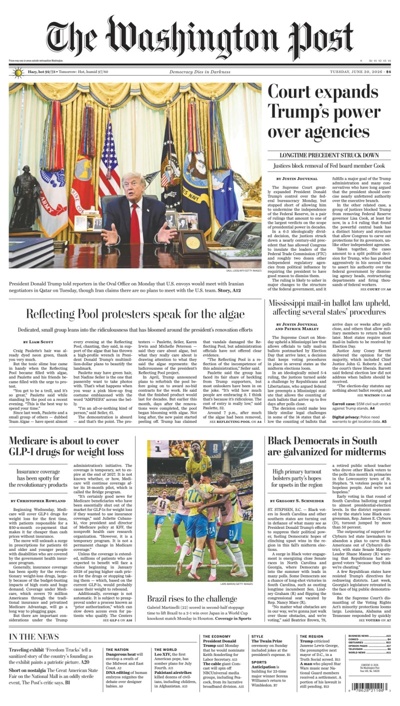
Washington Post
“Court expands Trump's power over agencies”
— Washington Post
The Court's expansion of presidential firing power is seen as a major blow to the independence of federal regulatory agencies.
The press immediately recognized the gravity of the ruling on presidential authority, but the tone varied wildly. The New_York_Times and Washington_Post adopted a somber, institutionalist tone, framing the decision as an erosion of the 'neutral' civil service. They provided historical context on the 'unitary executive theory,' suggesting this was the culmination of a decades-long conservative legal project.
In contrast, the New_York_Post celebrated the decision with a 'YOU’RE FIRED!' headline, stripping away the legal nuance to frame it as a personal victory for the incumbent's management style. This collective coverage reveals a media landscape that no longer views Supreme Court rulings as mere legal outcomes, but as partisan ammunition, with the Wall_Street_Journal notably highlighting the lone exception for the Federal Reserve as a necessary guardrail for the economy.
Notable angles
Wall Street Journal — Focuses specifically on the 'momentous' nature of the term as a check on the 'administrative state' rather than just a win for the President.
New York Post — Uses a pop-culture catchphrase to frame constitutional law as a populist victory.
Where papers diverged
Significant disagreement exists on the 'Mississippi mail-in' ruling; the Los_Angeles_Times and USA_Today framed it as a win for voters by allowing late ballots, while the New_York_Times and Chicago_Tribune focused on it as a validation of state-level procedural control.
Left out: Detailed analysis of the dissenting justices' specific legal reasoning was largely absent across all titles.
Also covered by 7 papers — click to enlarge
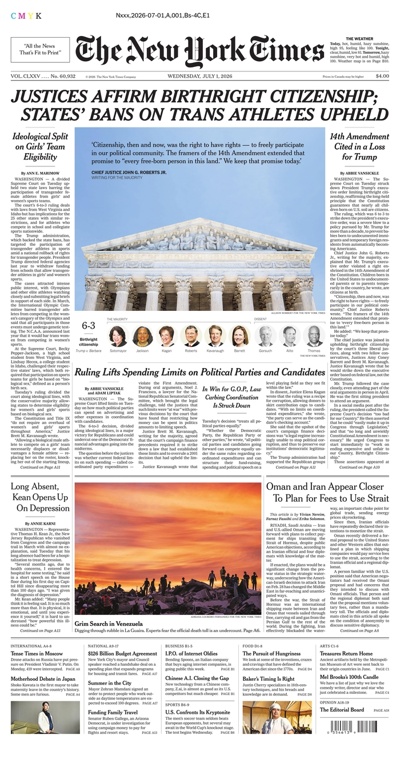
New York Times
“JUSTICES AFFIRM BIRTHRIGHT CITIZENSHIP; STATES’ BANS ON TRANS ATHLETES UPHELD”
— New York Times
A 'split' day for the Court as it protects birthright citizenship but permits restrictions on transgender athletes.
This day marked a shift from the 'machinery of government' to the 'politics of identity.' The affirmation of birthright citizenship was treated as a rare moment of consensus or 'relief' by the Minnesota_Star_Tribune and Houston_Chronicle, yet the simultaneous ruling on transgender athletes created a fractured front page. The New_York_Times attempted to balance both as co-equal constitutional events, whereas the New_York_Post ignored the citizenship ruling entirely in its lead to focus on the sports ban.
The coverage reveals an editorial struggle to define the Court's ideological direction. By upholding citizenship, the Court signaled a limit to executive overreach, yet by allowing sports bans, it signaled a willingness to defer to state-level social conservatism. The Philadelphia_Inquirer provided the most nuanced take, noting that while citizenship was upheld for 'most,' the legal door remained slightly ajar for future challenges.
Notable angles
New York Post — Aggressively exclusionary framing of the transgender sports ruling with the headline 'NO BOYS ALLOWED'.
Washington Post — Frames the citizenship ruling specifically as a personal defeat for the President's prior executive orders.
Where papers diverged
The New_York_Times and Philadelphia_Inquirer were the only papers to elevate the removal of political party spending limits to a major front-page concern, while others buried it under the social rulings.
Left out: The long-term impact of lifting campaign finance limits on electoral transparency was ignored by the majority of papers.
Also covered by 8 papers — click to enlarge
“Initial coverage of constitutional mechanics shifted into a broader cultural debate over identity and the 'right-wing' legacy of the current bench by day 7.”
Narrative Arc
The week began with a focus on the structural expansion of presidential power over the 'administrative state,' which the press initially framed as a technical legal shift. By mid-week, the narrative pivoted to social identity as the Court upheld birthright citizenship but allowed state-level bans on transgender athletes, revealing a bench that is aggressively interventionist across both governance and culture.
Dropped It
How Each Paper Evolved
Moved from technical analysis of agency power to a broader critique of the Court's 'enduring wins for the right wing' by the end of the week.
Maintained a focus on how the 'fractured' Court impacts individual rights and state-level autonomy.