
Paper Trail
Supreme Court Expansion of Executive Dismissal Powers
The Supreme Court issued a landmark ruling expanding the President's power to fire heads of regulatory agencies, while protecting the Federal Reserve's independence.
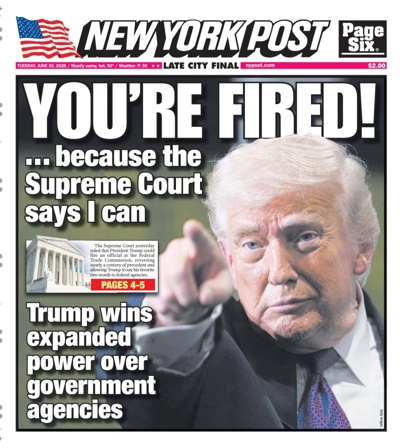
New York Post
“YOU’RE FIRED! ... because the Supreme Court says I can”
— New York Post
A significant expansion of presidential authority over the federal bureaucracy.
The coverage on June 30 was a study in linguistic framing. The New_York_Times used the term 'sway,' suggesting a subtle but pervasive influence, while the Washington_Post and Philadelphia_Inquirer used the more direct 'power to fire.' The New_York_Post took a characteristically populist tone with its 'YOU’RE FIRED!' headline, celebrating the decision as a personal win for Trump's management style.
Critically, the Wall_Street_Journal and Houston_Chronicle chose to lead with the exception—the Federal Reserve—framing the story as a balanced decision that preserved economic stability while reforming the executive branch. This highlights a divide between papers concerned with constitutional theory and those focused on market-moving institutional stability.
Notable angles
New York Post — Framed the ruling through the lens of Trump's 'Apprentice' persona, emphasizing personal dominance.
Wall Street Journal — Prioritized the protection of the Federal Reserve over the expansion of power elsewhere.
Where papers diverged
Significant disagreement on the 'winner' of the ruling; tabloids saw a total victory for the President, while broadsheets emphasized the judicial 'check' represented by the Fed exception.
Left out: The specific legal reasoning of the dissenting justices was almost entirely absent from the front-page summaries.
Also covered by 8 papers — click to enlarge
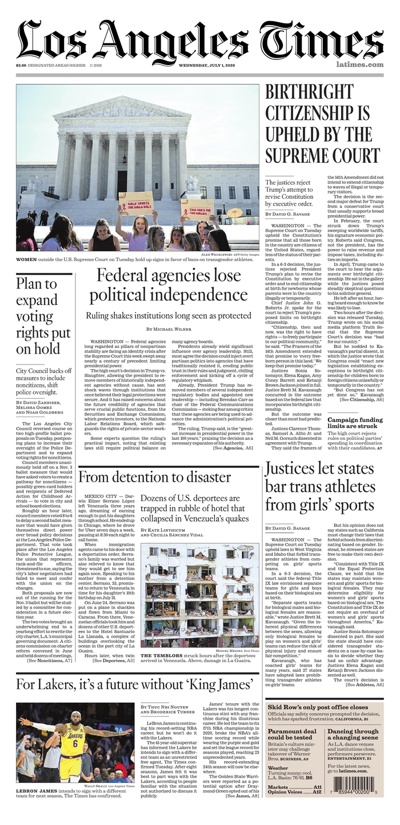
Los Angeles Times
“Federal agencies lose political independence”
— Los Angeles Times
The end of an era for independent federal agencies.
As the story moved into its second day, the Los_Angeles_Times provided the most somber assessment, moving the story to a secondary headline that focused on the loss of 'political independence.' This indicates a shift from reporting the 'event' of the ruling to analyzing its systemic 'consequences.'
While other papers moved on to the birthright citizenship ruling, the L.A. Times' persistence suggests an editorial priority on the long-term health of the administrative state. The lack of coverage elsewhere on July 1 suggests that the media cycle viewed the 'power' story as a one-day political event rather than an ongoing constitutional crisis.
Notable angles
Los Angeles Times — Explicitly used the phrase 'lose political independence' to describe the impact on agencies.
Left out: No mention of which specific agencies (beyond the Fed) might be first to face leadership changes.
“Initial reporting on the legal victory for Trump transitioned into a broader concern for the long-term independence of the 'administrative state' by day 7.”
Narrative Arc
The story broke as a major constitutional shift on June 30, with papers immediately dividing along ideological lines regarding the 'sway' or 'power' granted to the President. By July 1, the focus shifted to the practical erosion of 'political independence' for federal agencies as the ruling's implications were digested.
Dropped It
How Each Paper Evolved
Shifted from a neutral report on the ruling to a more pessimistic take on the loss of agency independence.