
Paper Trail
Presidential Billions and the Crypto Conflict
Financial disclosures revealing President Trump earned $2 billion in 2025, largely through cryptocurrency and Middle Eastern deals, sparked intense ethical scrutiny.
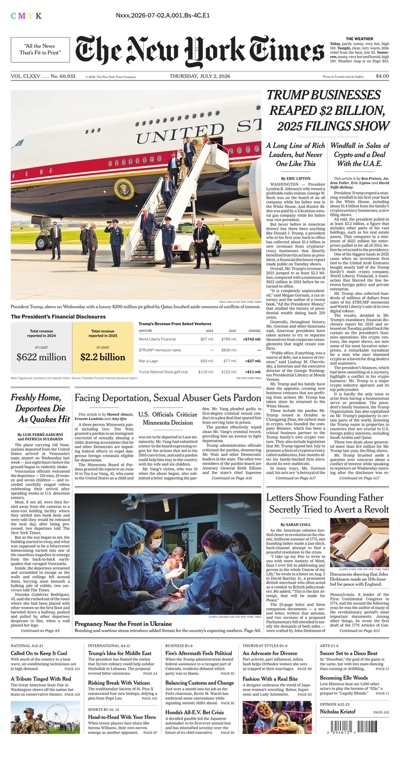
New York Times
“TRUMP BUSINESSES REAPED $2 BILLION, 2025 FILINGS SHOW”
— New York Times
The sheer scale of the President's 2025 income ($2 billion) raises unprecedented conflict-of-interest concerns.
The financial filings acted as a catalyst for a deep dive into the 'modern' presidency's intersection with global finance. The Wall_Street_Journal led with the Middle Eastern connection, providing a geopolitical lens to the earnings, while the New_York_Times focused on the 'shattered norms' of a sitting president reaping such vast sums.
This coverage highlights a media shift toward treating the presidency as a corporate entity. The Los_Angeles_Times was the most aggressive in its ethical framing, explicitly citing the Emoluments Clause—a term that had largely disappeared from the front pages since the first term. The papers collectively struggled to contextualize $2 billion, often resorting to listing the specific sources (crypto, licensing) to make the number tangible for readers.
Notable angles
Wall Street Journal — Focuses on the specific geographic source of the cash: Middle Eastern deals.
Chicago Tribune — Highlights cryptocurrency as the primary engine of the windfall.
Where papers diverged
The Minnesota_Star_Tribune treated the story as a secondary economic item, whereas the coastal broadsheets framed it as a primary political scandal.
Left out: No paper provided a detailed response from the Trump Organization or the White House regarding the separation of duties.
Also covered by 6 papers — click to enlarge
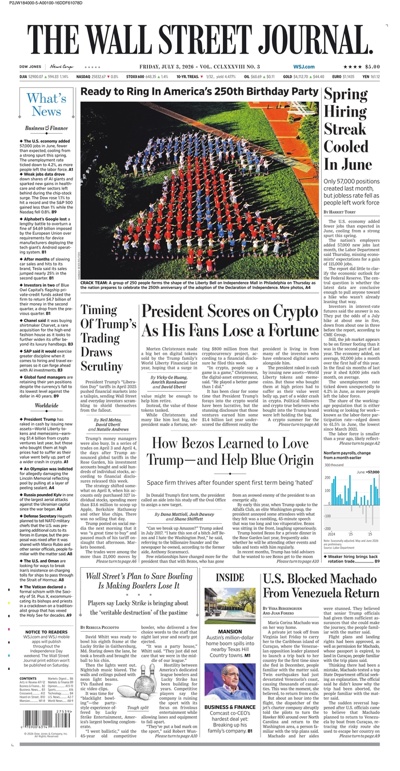
Wall Street Journal
“President Scores on Crypto As His Fans Lose a Fortune”
— Wall Street Journal
The President's crypto profits are contrasted with the heavy losses suffered by his retail-investor base.
On this day, the narrative became moralistic. The Wall_Street_Journal and New_York_Times both ran lead stories that were effectively 'post-mortems' on a crypto crash, but with a political twist: the President got out (or stayed up) while his 'fans' lost everything. This is a sophisticated framing shift—it moves the story from 'is he too rich?' to 'is he profiting at the expense of his voters?'
The editorial choice to use the word 'fans' (WSJ) or 'investors' (NYT) reflects a subtle disagreement on the nature of the President's relationship with his base. The coverage reveals a press corps looking for the 'hypocrisy' angle to make a complex financial story resonate with a broader audience. By focusing on the 'timing' of the trades, the papers are hinting at insider knowledge without explicitly alleging it, a cautious but pointed editorial stance.
Notable angles
Wall Street Journal — Directly links the President's gain to his supporters' 'fortune' lost.
Left out: Technical analysis of the market mechanics behind the crypto crash was entirely missing.
Also covered by 3 papers — click to enlarge
“Initial reporting on the scale of wealth transitioned into a focused ethical critique of 'insider' gains versus 'outsider' losses.”
Narrative Arc
The story broke as a massive figure ($2 billion) and quickly evolved into a 'winners and losers' narrative. By day 4, the press was contrasting the President's personal windfall with the financial ruin of his supporters who invested in the same volatile assets.
Dropped It
How Each Paper Evolved
Evolved from reporting the $2 billion figure to analyzing the 'shattered norms' and the specific crypto-disparity.
Shifted from a focus on Middle Eastern deals to the scrutiny of the President's trading 'timing'.