
Paper Trail
Diplomatic Brinkmanship and Military Escalation with Iran
A week that began with contested maritime closures and high-level diplomatic talks in Switzerland ended in direct U.S. military strikes following a Senate attempt to curb war powers.
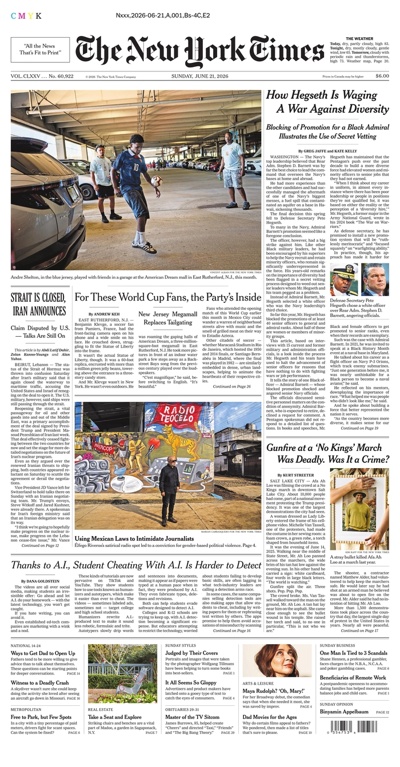
New York Times
“STRAIT IS CLOSED, IRAN ANNOUNCES”
— New York Times
Iran's announcement of the Strait of Hormuz closure is framed as a direct challenge to U.S. economic and maritime authority.
Notable angles
Philadelphia Inquirer — Focuses specifically on Trump's threat to charge U.S. tolls as a response to the blockade.
Where papers diverged
The New_York_Times accepts the closure as a fait accompli in its headline, whereas the Chicago_Tribune frames it as a 'threat' and a 'debate' over tolls.
Left out: The specific status of the Swiss diplomatic negotiations was largely ignored in favor of the immediate maritime crisis.
Also covered by 4 papers — click to enlarge
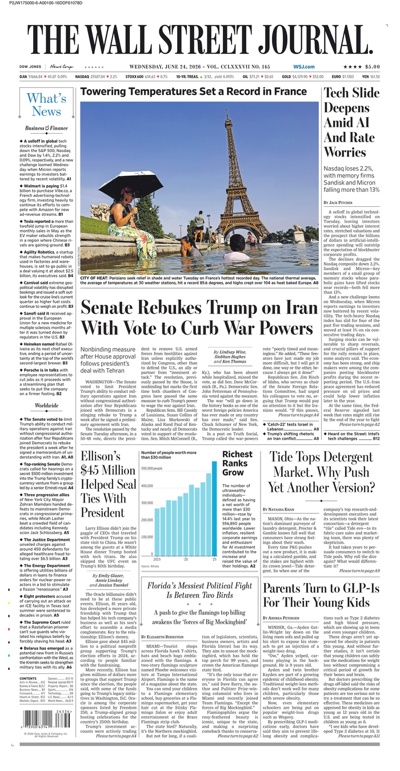
Wall Street Journal
“Senate Rebukes Trump on Iran With Vote to Curb War Powers”
— Wall Street Journal
The Senate's passage of the War Powers Resolution is framed as a historic rebuke of President Trump's executive authority.
Notable angles
Chicago Tribune — Links the conflict specifically to a dispute over nuclear inspections rather than general war powers.
Where papers diverged
While most papers focused on the Senate's defiance, the Arizona_Republic highlighted Trump's claim that Iran had already agreed to inspections, presenting a more optimistic, administration-aligned view.
Left out: The specific vote counts and the names of dissenting Senators were omitted in favor of broad 'institutional' framing.
Also covered by 6 papers — click to enlarge
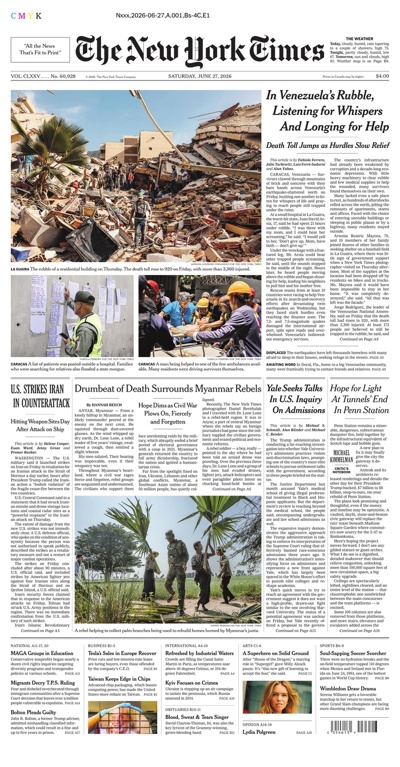
New York Times
“U.S. STRIKES IRAN IN COUNTERATTACK”
— New York Times
The transition from diplomacy to kinetic action is confirmed by U.S. counterattacks on Iranian sites.
Notable angles
Wall Street Journal — Uses satellite imagery to emphasize the physical damage to U.S. naval infrastructure.
Where papers diverged
The New_York_Times frames the strikes as a 'counterattack,' implying a defensive posture, while the Washington_Post uses more neutral 'attacks sites' language.
Left out: The status of Vice President Vance, the face of the week's earlier diplomacy, was notably absent from the strike coverage.
Also covered by 3 papers — click to enlarge
“Initial diplomatic process-oriented coverage gave way to institutional conflict between branches of government before culminating in military escalation.”
Narrative Arc
The narrative transitioned from cautious diplomatic optimism led by VP Vance to a constitutional crisis between the Senate and President Trump. By the week's end, the failure of negotiations was punctuated by a return to kinetic warfare and direct U.S. counterattacks.
Dropped It
Picked It Up
How Each Paper Evolved
Shifted from reporting Iranian announcements to focusing on the domestic cultural impact of the war, and finally to the military counterstrikes.
Maintained a consistent focus on the economic and institutional levers of the conflict, from oil sales in dollars to the Senate's war powers vote.
Focused heavily on the technical and procedural aspects, such as tolls and nuclear inspections, before dropping the story as it turned into a direct military conflict.