
Paper Trail
US-Iran Negotiations: From Ceasefire Framework to Military Escalation
A fragile diplomatic effort to end regional hostilities transitioned from a tentative ceasefire agreement to renewed military strikes and stalled talks.

Arizona Republic
“TRUMP: IRAN ‘NEGOTIATING ON FUMES’”
— Arizona Republic
The administration is maintaining a hardline stance despite internal and external pressures to de-escalate.
The Washington Post and Arizona Republic set the tone by framing the President’s position as one of domestic political necessity, with the Republic noting the administration's belief that Iran is 'negotiating on fumes.' There is a palpable sense of administrative theater here, where the 'firm terms' are presented as a shield against midterm election influence.
While regional papers like the Houston Chronicle and Minneapolis Star_Tribune focus on the President's refusal to let politics dictate war strategy, the New_York_Times offers a more detached, analytical view, labeling the situation 'The War in Iran, According to Trump.' This suggests a growing divide between the White House narrative and the ground reality as perceived by elite coastal press.
Notable angles
Arizona Republic — Uses aggressive 'negotiating on fumes' rhetoric to suggest Iranian weakness.
Where papers diverged
The Washington Post frames the stance as 'firm' resolve, whereas the Chicago Tribune highlights 'conflicting messages' on the actual status of the talks, suggesting internal administration chaos.
Left out: Lack of context regarding the economic impact of oil price rises on the negotiation leverage.
Also covered by 6 papers — click to enlarge

Washington Post
“U.S. and Iran reach a loose framework to end Mideast war”
— Washington Post
A tentative diplomatic breakthrough has been reached, though it awaits final presidential sign-off.
The Washington Post elevates the 'loose framework' to its primary lead, signaling a major pivot toward peace. This coverage provides a rare moment of diplomatic optimism, focusing on the mechanics of a 'Mideast war' exit strategy. The framing suggests the administration is finally moving toward a concrete resolution.
In contrast, the Houston Chronicle and Tampa_Bay_Times maintain a skeptical distance, emphasizing that Trump 'yet to OK' or 'yet to sign' the pact. This cautious local framing contrasts with the Post’s more definitive 'U.S. and Iran reach a framework,' revealing a media disagreement over whether a deal exists without a final signature.
Notable angles
Washington Post — Treats the 'loose framework' as a fait accompli to end the war.
Where papers diverged
The Post frames the framework as a success; regional papers frame it as an unconfirmed rumor pending Trump's personal approval.
Left out: Detailed analysis of the sanctions relief mechanisms required for the deal to hold.
Also covered by 5 papers — click to enlarge
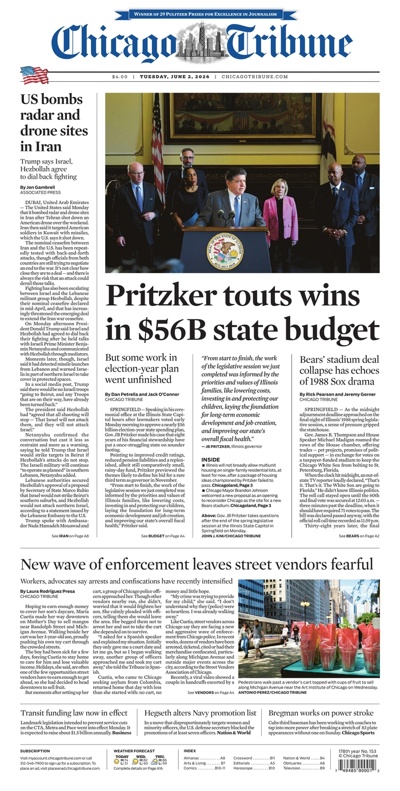
Chicago Tribune
“US bombs radar and drone sites in Iran”
— Chicago Tribune
Diplomacy has collapsed into active military engagement and 'tit-for-tat' strikes.
The narrative has curdled from the optimism of May 29 into a grim reality of 'trade strikes.' The Chicago Tribune reporting on US bombing of radar sites marks a definitive end to the ceasefire narrative. The New_York_Times provides a scathing meta-commentary, noting that in these stalemates, 'Trump’s Talk Meets Reality,' suggesting his diplomatic style has finally hit an immovable wall.
The Washington Post highlights the failure of the 'Board of Peace' in Gaza, painting a picture of an administration whose peace initiatives are 'foundering' due to a lack of resources. The collective coverage reveals a shift from treating the negotiations as a bilateral US-Iran issue to a broader, messier regional conflagration involving Lebanon and Israel.
Notable angles
Washington Post — Focuses on the collapse of the 'Board of Peace' as a specific policy failure.
New York Times — Frames the collapse as a failure of Trump's personal negotiating style.
Where papers diverged
While the Wall_Street_Journal claims Trump is still 'seeking end to conflict,' the Arizona Republic and Chicago Tribune report that Iran has suspended talks entirely due to Israeli raids, indicating a disconnect in how 'active' the peace process remains.
Left out: Depth on the internal Iranian leadership debate regarding whether to return to the table.
Also covered by 9 papers — click to enlarge
“Initial reporting on diplomatic breakthroughs was replaced by a focus on military 'aftershocks' and the collapse of negotiations by Day 6.”
Narrative Arc
The week began with the administration projecting 'maximum pressure' resolve, which briefly shifted into optimism as a 'loose framework' for peace was reported on May 29. However, by early June, this diplomatic momentum evaporated, replaced by headlines of tit-for-tat missile strikes and public disagreements between US and Israeli leadership.
Picked It Up
How Each Paper Evolved
Shifted from reporting 'firm terms' to declaring a 'loose framework' for peace, before finally documenting the 'foundering' of the peace board and renewed strikes.
Moved from aggressive 'fumes' rhetoric to highlighting the 'bind' Trump faced, ending with the 'shrouded' mystery of conflict-related violence.
Consistent focus on the uncertainty and military 'aftershocks' rather than diplomatic optimism.