
Paper Trail
Collapse of Diplomacy and Direct Military Escalation
A week of deteriorating Middle East stability saw fragile peace negotiations give way to direct missile exchanges between Iran and Israel.
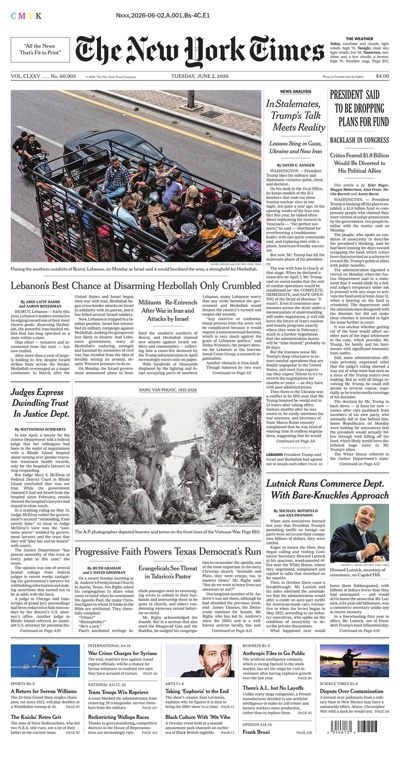
New York Times
“Lebanon’s Best Chance at Disarming Hezbollah Only Crumbled”
— New York Times
Diplomatic efforts are faltering as regional actors test military boundaries.
The New_York_Times leads with a post-mortem on Lebanese diplomacy, suggesting that the 'best chance' for peace has already passed. This sets a somber, analytical tone that contrasts with the more tactical reporting in the Chicago_Tribune, which focuses on the immediate mechanics of U.S. bombing raids on Iranian drone sites.
There is a palpable sense of a 'waiting game' across the broadsheets. While the Wall_Street_Journal notes Trump's desire to end the conflict, the Washington_Post highlights the reality of trading strikes, suggesting a disconnect between executive rhetoric and the kinetic reality on the ground. The collective coverage reveals a press corps skeptical of imminent de-escalation.
Notable angles
New York Times — Focuses on the structural collapse of Hezbollah disarmament as the primary driver of instability.
Wall Street Journal — Frames the conflict through the lens of Trump's personal 'talk meeting reality' in foreign policy.
Where papers diverged
A clear split exists between national papers focusing on the 'why' of diplomatic failure (NYT, WP) and regional papers like the Chicago_Tribune and Philadelphia_Inquirer that prioritize the 'what' of military strikes and immediate ceasefire fragility.
Left out: Lack of insight into internal Iranian political divisions regarding the suspension of talks.
Also covered by 9 papers — click to enlarge
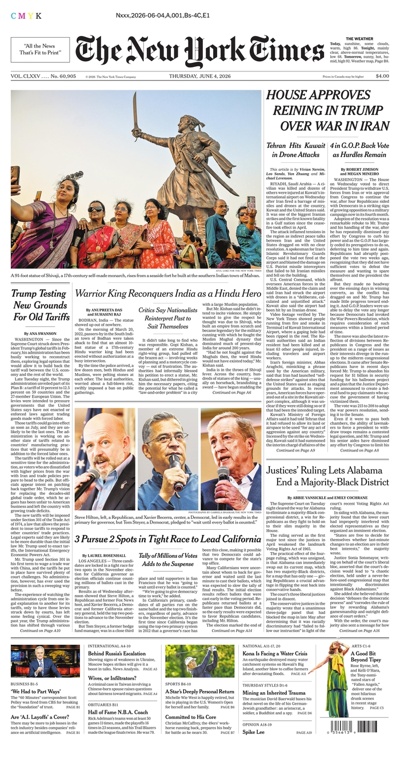
New York Times
“HOUSE APPROVES REINING IN TRUMP OVER WAR IN IRAN”
— New York Times
The U.S. House of Representatives asserts constitutional authority to limit executive war powers against Iran.
The New_York_Times and Wall_Street_Journal both elevate the House resolution to a major constitutional showdown. By using words like 'Reining In' and 'Rebuffs,' they frame the story not just as a foreign policy disagreement, but as a domestic power struggle between the branches of government.
Interestingly, the Arizona_Republic provides a counter-narrative by highlighting Trump's claim that Iran has agreed to 'no nukes for now,' suggesting a desperate attempt by the administration to project diplomatic success even as Congress moves to clip its wings. This creates a jarring contrast between legislative alarm and executive optimism.
Notable angles
Arizona Republic — Gives significant weight to Trump's claim of a nuclear agreement, which other papers largely ignore or treat with skepticism.
Where papers diverged
National broadsheets treat the House vote as a historic rebuke, while the Chicago_Tribune relegates it to a secondary headline, prioritizing local mayoral politics.
Left out: No analysis of the Senate's likely reception of the war powers resolution.
Also covered by 5 papers — click to enlarge
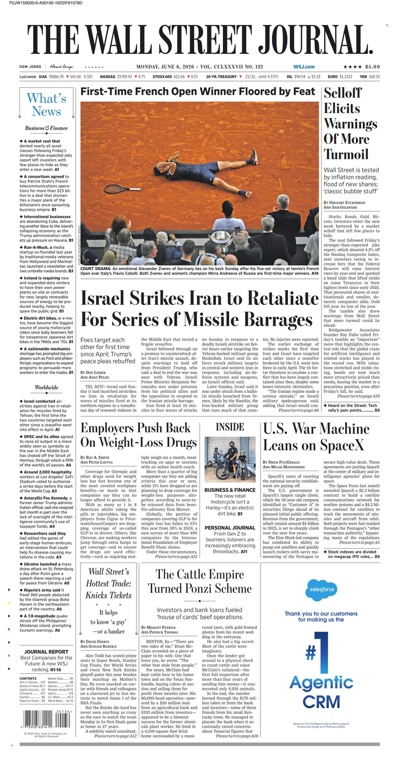
Wall Street Journal
“Israel Strikes Iran to Retaliate For Series of Missile Barrages”
— Wall Street Journal
Direct military engagement between Iran and Israel marks a point of no return for regional stability.
The tone has shifted from political maneuvering to high-stakes military reporting. The Wall_Street_Journal's headline 'Israel Strikes Iran to Retaliate' signals a definitive move into a state of active war, moving beyond the 'proxy' framing of earlier in the week.
The New_York_Times and Washington_Post both emphasize the 'trade' of attacks, suggesting a cycle of violence that is now self-sustaining. The Houston_Chronicle's inclusion of the story on its front page signifies that the crisis has reached a level of gravity that overrides local concerns, a rare occurrence for the paper during this window.
Notable angles
Washington Post — Emphasizes the reciprocal nature of the attacks as a direct threat to any remaining peace negotiations.
Where papers diverged
While all papers agree on the fact of the strikes, the Wall_Street_Journal is more explicit in framing the Israeli response as a direct retaliation for Iranian barrages, whereas the NYT focuses on the broader collapse of the ceasefire.
Left out: Detailed casualty figures or technical assessments of the missile systems used.
Also covered by 5 papers — click to enlarge
“Initial coverage of diplomatic 'obstacles' and 'stalemates' shifted to a framing of direct military confrontation and the failure of international mediation by day 7.”
Narrative Arc
The week began with papers like the New York Times and Washington Post highlighting the crumbling of Lebanese diplomacy and shaky U.S.-Iran trade strikes. By mid-week, the focus shifted to domestic U.S. legislative attempts to rein in executive war powers, before culminating in a full-scale regional crisis as Iran and Israel engaged in direct retaliatory strikes. The alarm level rose significantly as headlines transitioned from 'stalemates' to 'missile attacks.'
Dropped It
Picked It Up
How Each Paper Evolved
Moved from analytical mourning of diplomacy to framing the conflict as a constitutional crisis, and finally to urgent war reporting.
Consistently focused on the tension between Trump's rhetoric and the strategic military reality.
Maintained a focus on the 'tit-for-tat' nature of the strikes and the resulting diplomatic paralysis.