
Paper Trail
From Missile Barrages to a Trillionaire's Peace
A week of direct military exchanges between Iran, Israel, and the U.S. transitioned into a fragile diplomatic breakthrough coincided with domestic economic pressure.
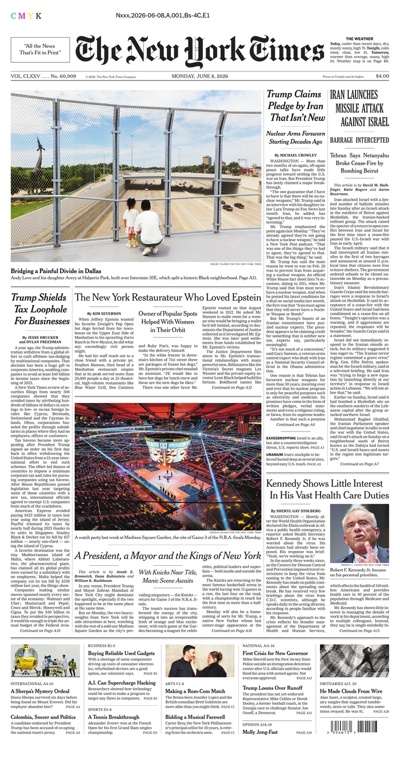
New York Times
“IRAN LAUNCHES MISSILE ATTACK AGAINST ISRAEL”
— New York Times
Direct military confrontation between Iran and Israel is treated as a historic breakdown of regional stability.
The New_York_Times and Wall_Street_Journal both lead with high-octane military framing, but their underlying anxieties differ. The Times focuses on the tactical 'sequence of retaliatory strikes,' treating the event as a failure of specific ceasefire mechanisms. Meanwhile, the Wall_Street_Journal adopts a more hawkish strategic lens, emphasizing the 'failure of diplomatic intervention' and the broader strategic implications for the U.S. war machine.
What is striking is the Washington_Post's choice to frame the attacks primarily as a 'threat to ongoing peace negotiations.' This suggests an editorial hope for a diplomatic off-ramp even as missiles were in the air. The collective coverage reveals a press corps caught between the visceral reality of kinetic warfare and the established narrative of a 'negotiated settlement' that had dominated the previous weeks.
Notable angles
Washington Post — Frames the military strikes specifically as a reciprocal threat to existing peace negotiations rather than just a tactical exchange.
Where papers diverged
While all papers agree on the severity, the Wall_Street_Journal links the conflict to technology and the 'U.S. War Machine's' reliance on SpaceX, a thread other papers ignore in favor of pure geopolitics.
Left out: Detailed technical analysis of missile capabilities or verified casualty figures.
Also covered by 5 papers — click to enlarge
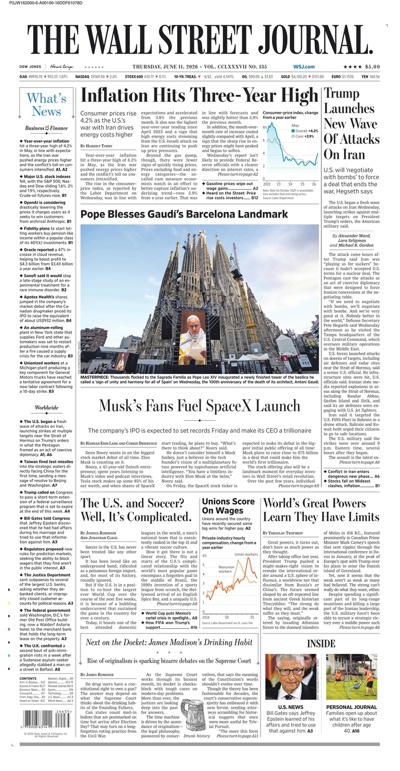
Wall Street Journal
“Inflation Hits Three-Year High”
— Wall Street Journal
The geopolitical crisis is now inextricably linked to domestic economic pain as inflation surges.
This day marks a significant pivot where 'War' and 'Wallet' collide. The Wall_Street_Journal and Philadelphia_Inquirer both elevate inflation to the lead, explicitly connecting the 'intensifying' Iran war to a three-year high in consumer prices. This framing shifts the story from a distant foreign policy matter to a direct threat to the American household, significantly raising the political stakes for the administration.
The New_York_Times highlights Trump's 'frustration with talks,' signaling a move toward 'coercive diplomacy.' By naming the President's personal emotional state in the headline, the Times frames the escalation as a product of executive temperament rather than just military necessity. The Arizona_Republic goes further, quoting a direct threat that Iran will 'pay' for delays, emphasizing a hardening of the American rhetorical stance.
Notable angles
Minnesota Star Tribune — Explicitly links the jump in inflation to the intensification of the Iran war in its lead headline.
Arizona Republic — Focuses on the personal ultimatum issued by Trump regarding the 'cost' of delaying a deal.
Where papers diverged
The Los_Angeles_Times and Washington_Post maintain a focus on the 'truce on the brink,' while the Wall_Street_Journal almost entirely pivots to the macroeconomic fallout of the conflict.
Left out: The reported deaths of Indian sailors in the conflict zone were omitted from all major front pages.
Also covered by 7 papers — click to enlarge
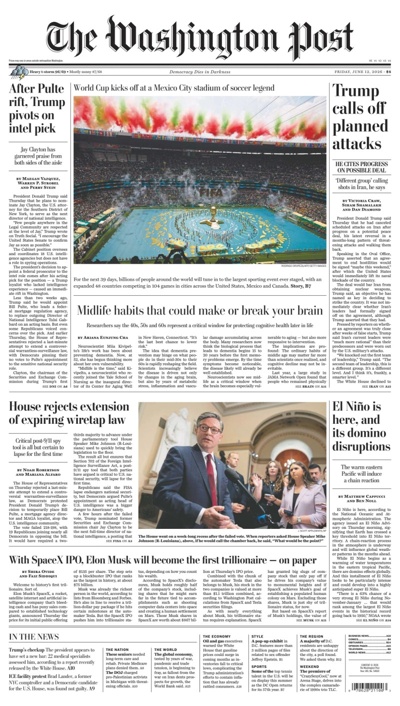
Washington Post
“Trump calls off planned attacks”
— Washington Post
A sudden de-escalation as the administration claims a diplomatic breakthrough is imminent.
The New_York_Times leads with a skeptical 'Pivoting Again' framing, suggesting the administration's reversal is erratic rather than strategic. This 'whiplash' narrative is echoed by the Minnesota_Star_Tribune, which uses the verb 'whipsaws' to describe the shift from threats to deal-making. It reveals a deep editorial distrust of the official rationale for canceling the strikes.
In contrast, the Washington_Post and Arizona_Republic provide a more process-oriented account, focusing on the 'progress' cited by officials. The divergence here is purely tonal: the coastal 'prestige' press treats the move as a chaotic flip-flop, while regional papers like the Republic report it as a straightforward de-escalation. This highlights a divide in how much 'intent' the media ascribes to the administration's rapid shifts in foreign policy.
Notable angles
New York Times — Uses the phrase 'Pivoting Again' to characterize the administration's reversal as part of a pattern of inconsistency.
Where papers diverged
The New_York_Times and Minnesota_Star_Tribune emphasize the 'reversal' and 'whipsaw' nature of the policy, while the Washington_Post adopts a more neutral, process-heavy tone.
Left out: Public rebuttals from Iranian officials calling the 'deal' speculative were missing from these front pages.
Also covered by 7 papers — click to enlarge
“Initial military alarmism and 'retaliation' framing shifted to economic anxiety and 'coercive diplomacy' by mid-week.”
Narrative Arc
The week began with high-alarm coverage of direct missile exchanges, peaking with the downing of a U.S. helicopter on June 10. By June 11, the narrative pivoted to the domestic cost of conflict as inflation hit a three-year high, prompting a sudden administration shift toward 'claiming a deal' by June 12. The window closed with a cautious optimism as regional mediators like Pakistan signaled a final pact was imminent.
Picked It Up
How Each Paper Evolved
Moved from tactical military reporting to a highly critical 'erratic policy' frame by the end of the week.
Shifted from strategic military analysis to a dominant focus on the conflict's impact on global markets and inflation.
Consistent focus on the role of regional mediators like Pakistan and the direct rhetoric of the administration.