
Paper Trail
Escalation and Economic Fallout of US-Iran War
Direct military conflict between the US and Iran expanded from maritime strikes to regional land-based exchanges, resulting in American casualties and global energy price spikes.
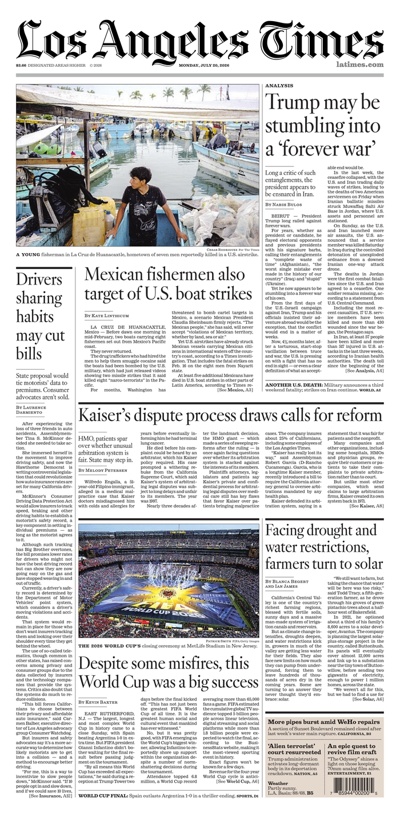
Los Angeles Times
“Trump may be stumbling into a ‘forever war’”
— Los Angeles Times
The conflict is framed as a looming 'forever war' triggered by retaliatory strikes and American casualties.
The Los Angeles Times sets a critical tone, explicitly warning that the administration may be 'stumbling' into an endless conflict, a framing that contrasts sharply with the more clinical, factual reporting of casualties in the Philadelphia Inquirer and Minnesota Star Tribune. This early split suggests a media landscape divided between strategic alarmism and patriotic solemnity.
Notably, the Wall Street Journal begins to widen the lens beyond direct US-Iran exchanges, identifying Jordan as a critical emerging focus. This indicates an early editorial awareness that the conflict was rapidly outgrowing its initial maritime boundaries in the Strait of Hormuz.
Notable angles
Los Angeles Times — Frames the conflict as a potential long-term strategic failure and a 'forever war'.
Where papers diverged
While most papers focused on the immediate human cost of drone strikes, the Los Angeles Times was unique in linking the conflict to broader regional issues like Mexican fishermen being caught in boat strikes, suggesting a more chaotic theater of operations than the Pentagon's 'neutralization' narrative.
Left out: None of the papers explicitly detail the collapse of the specific memorandum of understanding regarding the Strait of Hormuz.
Also covered by 7 papers — click to enlarge
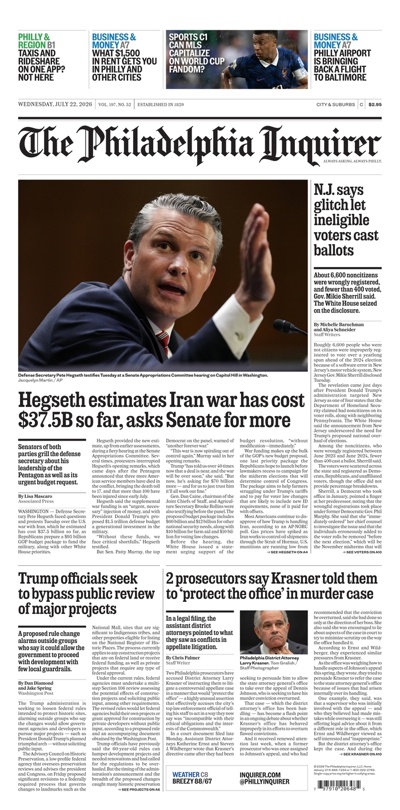
Philadelphia Inquirer
“Hegseth estimates Iran war has cost $37.5B so far, asks Senate for more”
— Philadelphia Inquirer
Bipartisan scrutiny intensifies as the financial and strategic costs of the conflict become the primary political focus.
The Philadelphia Inquirer takes the lead on fiscal accountability, splashing the $37.5 billion cost figure across its front page. This represents a significant pivot from the previous days' focus on the 'dignity' of the fallen to the 'dollars' of the campaign. The tone is increasingly adversarial toward the administration's lack of strategy.
The Wall Street Journal adds a layer of military skepticism, noting that Tehran's missile barrages prove the U.S. has failed to 'erase' the lethal threat despite eleven nights of strikes. This collective coverage reveals a growing editorial consensus that the military campaign is neither cheap nor particularly effective, forcing a shift from 'rally-around-the-flag' reporting to 'oversight' reporting.
Notable angles
Wall Street Journal — Questions the effectiveness of the U.S. campaign by highlighting persistent Iranian missile capabilities.
Philadelphia Inquirer — Prioritizes the $37.5B fiscal cost and the Senate's demand for strategic clarity.
Where papers diverged
The Tampa Bay Times and Chicago Tribune maintain a focus on the stalling of Mideast diplomacy, whereas the Minnesota Star Tribune highlights the specific threat of Houthi rebels widening the war, showing a split between diplomatic and tactical emphasis.
Left out: None of these papers mentions the closure of the Hormuz and Bab al-Mandeb straits or the resulting impact on regional and global trade.
Also covered by 10 papers — click to enlarge
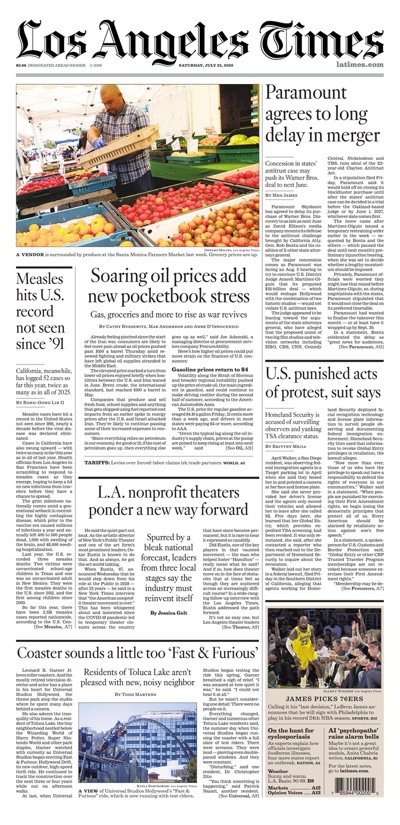
Los Angeles Times
“Soaring oil prices add new pocketbook stress”
— Los Angeles Times
The conflict's consequences shift to domestic economic pressure and direct threats to U.S. leadership.
The narrative reaches a fever pitch as the New York Times reports Trump had to switch aircraft due to threats from Iranian proxies, a dramatic escalation in the 'personalization' of the conflict. Simultaneously, the Los Angeles Times pivots to the 'pocketbook stress' of soaring oil prices, signaling that the war has finally hit the American consumer.
This day's coverage reveals a media transition from treating the war as a 'foreign' policy issue to a 'domestic' crisis. The Wall Street Journal's report on Bahrain and Kuwait launching rare reprisals against Iran suggests a total breakdown of regional order, which the papers are now linking directly to the price of gas at home.
Notable angles
New York Times — Focuses on the direct security threat to the President, necessitating a change in aircraft.
Los Angeles Times — Frames the entire geopolitical crisis through the lens of 'pocketbook stress' for Californians.
Where papers diverged
The Arizona Republic remains focused on the tactical (strikes by the Caspian coast), while the Houston_Chronicle highlights Saudi Arabia's entry into the Yemen theater, showing disagreement on which regional escalation is most significant.
Left out: Detailed analysis of the diplomatic efforts or potential de-escalation strategies currently being pursued by international mediators.
Also covered by 5 papers — click to enlarge
“Initial focus on dignified transfers and military retaliation shifted to domestic pocketbook stress and congressional challenges to executive war powers.”
Narrative Arc
Coverage began with somber reports of service member deaths and 'forever war' warnings, transitioning by mid-week into a focus on the massive $37.5B fiscal cost and legislative scrutiny. By the final days, the narrative shifted from kinetic military action to the tangible domestic economic impact, specifically soaring oil prices and diesel shortages for farmers.
Dropped It
Picked It Up
How Each Paper Evolved
Moved from high-level warnings of a 'forever war' to specific reports on the economic burden of oil prices on households.
Shifted from reporting regional troop movements to questioning the tactical efficacy of U.S. strikes against Iranian missile threats.
Evolved from somber casualty reporting to an aggressive focus on the $37.5B fiscal transparency of the war.