
Paper Trail
US-Iran Military Conflict and Strait Blockade
A series of reciprocal military strikes between the U.S. and Iran escalated into a formal naval blockade and a transactional dispute over transit tolls in the Strait of Hormuz.
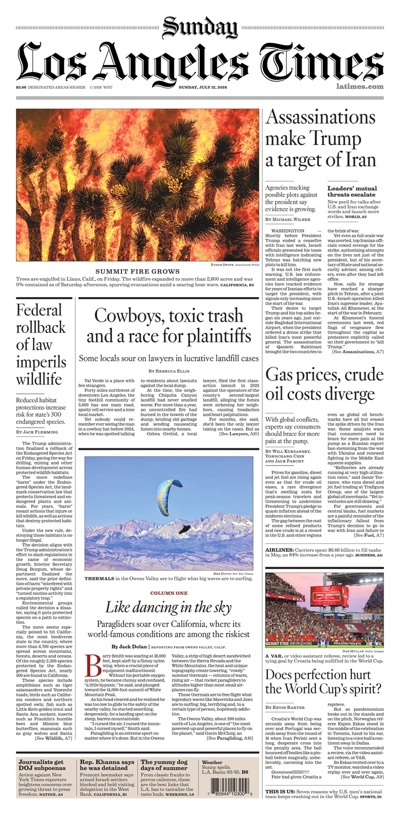
Los Angeles Times
“Assassinations make Trump a target of Iran”
— Los Angeles Times
Initial strikes are framed as a response to direct threats against U.S. leadership.
The Los_Angeles_Times sets a high-alarm tone by linking regional strikes directly to 'assassination' threats against President Trump, personalizing the geopolitical conflict. This choice elevates the story from a standard military exchange to a matter of national executive security.
In contrast, the Chicago_Tribune treats the event with clinical brevity, placing it as a secondary factual update. This divergence suggests a press corps undecided on whether this is a temporary flare-up or the start of a major campaign, with papers failing to mention the strategic closure of the Strait of Hormuz entirely.
Notable angles
Los Angeles Times — Focuses on intelligence reports of Iranian plots against the U.S. President rather than the strikes themselves.
Where papers diverged
Significant gap in perceived urgency; the LA Times treats it as a lead security crisis while the Chicago Tribune treats it as a routine military brief.
Left out: Neither paper addresses the immediate economic impact of the Strait's closure on global energy markets.
Also covered by 2 papers — click to enlarge

New York Post
“STRAIT FLU$H”
— New York Post
The conflict pivots to transactional economic warfare via a naval blockade and transit tolls.
The narrative undergoes a radical shift as the Trump administration introduces the concept of 'transit tolls' for the Strait. The New_York_Post captures this transactional spirit with its 'STRAIT FLU$H' headline, framing the military blockade as a revenue-generating exercise. This marks a departure from traditional 'freedom of navigation' rhetoric toward a more mercantilist foreign policy.
The Wall_Street_Journal provides the necessary sober counterpoint, highlighting how this 'transactional' approach is causing oil prices to leap. The collective coverage reveals a fascination with the administration's unconventional methods, even as the Arizona_Republic warns that the two nations are now 'trading fire' in a deepening dispute.
Notable angles
New York Post — Uses a gambling pun to frame the blockade as a winning financial move for the U.S.
Wall Street Journal — Focuses on the depletion of the Strategic Petroleum Reserve and the resulting oil price spike.
Where papers diverged
While most papers focused on the policy of the blockade, the Arizona Republic was the only one to emphasize the active 'trading of fire' as a bilateral escalation.
Left out: Total lack of discussion regarding the legality of transit tolls under the Law of the Sea Convention.
Also covered by 9 papers — click to enlarge
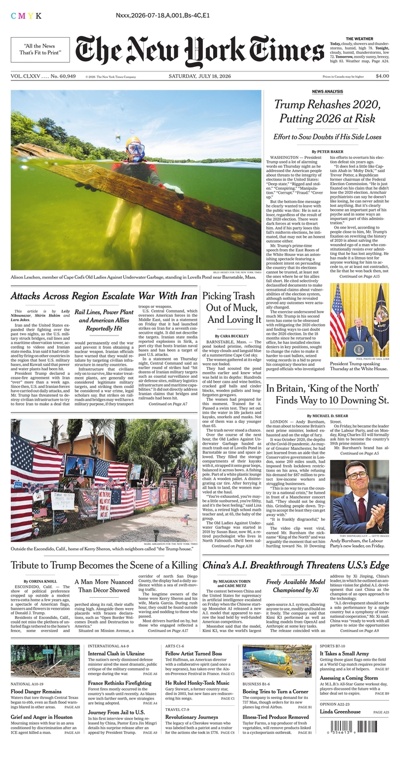
New York Times
“Attacks Across Region Escalate War With Iran”
— New York Times
Conflict reaches a peak with infrastructure destruction and fears of a regional war.
By the end of the week, the 'toll' rhetoric has faded, replaced by the grim reality of infrastructure warfare. The Washington_Post reports on the destruction of 'plants and bridges,' signaling that the conflict has moved beyond maritime skirmishes into a systematic air campaign. The tone is one of weary resignation to a broadening conflict.
The New_York_Times frames this as a full-scale 'War with Iran,' a significant escalation in terminology from the 'strikes' and 'tensions' used earlier in the week. The coverage suggests that the diplomatic off-ramps have been bypassed, and the press is now bracing for a long-term regional conflagration.
Notable angles
Washington Post — Specifically details the destruction of civilian infrastructure like bridges as reported by Iran.
Where papers diverged
The New York Post remains focused on the 'decisive' nature of the response, while the Washington Post and NYT focus on the humanitarian and strategic risks of hitting infrastructure.
Left out: No reporting on the specific terms of the failed ceasefire that could have prevented this week's escalation.
Also covered by 3 papers — click to enlarge
“Initial tactical reporting on strikes evolved into economic warfare framing by day 3, before settling into a 'forever war' narrative by day 6.”
Narrative Arc
The story began as localized military friction before shifting into a policy-heavy debate over Trump's 'Strait Toll' and naval blockade. By the end of the week, the narrative returned to high-intensity military conflict as infrastructure strikes replaced diplomatic posturing.
Dropped It
Picked It Up
How Each Paper Evolved
Shifted from reporting on survivors of attacks to a focus on the diplomatic 'impasse' and finally the destruction of infrastructure.
Maintained a factual, low-prominence stance early on before elevating the story to 'Hazardous' status as regional stability collapsed.