
Paper Trail
Collapse of U.S.-Iran Ceasefire and Military Escalation
A fragile truce between Washington and Tehran disintegrated into direct military strikes and threats against executive leadership.
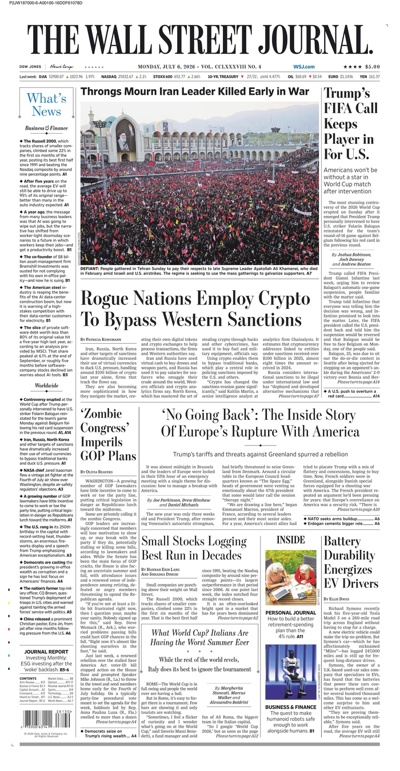
Wall Street Journal
“Throngs Mourn Iran Leader Killed Early in War”
— Wall Street Journal
Mourning for the late Ayatollah Ali Khamenei serves as a backdrop for rising regional hard-line sentiment.
The Wall_Street_Journal and Chicago_Tribune focus on the visual and symbolic weight of the funeral for the Iranian leader, framing it as a moment of consolidation for the regime's hard-liners. This isn't just a state funeral; it's presented as a mobilization of anti-Western sentiment during a period of extreme vulnerability.
The Washington_Post provides a more analytical layer, warning that the regime is becoming 'ruthless' and 'savvier' in the wake of the leadership vacuum. The collective press tone is one of 'the calm before the storm,' where the lack of an immediate successor creates a volatile environment that papers are clearly bracing for.
Notable angles
Washington Post — Focuses on the internal psychological shift of the Iranian regime toward a more uncompromising stance.
Where papers diverged
The Wall_Street_Journal emphasizes the geopolitical 'war' context, while the Chicago_Tribune treats the funeral more as a significant international news event without the same level of strategic alarm.
Left out: Lack of specific details on the interim leadership structure in Tehran during the transition.
Also covered by 3 papers — click to enlarge
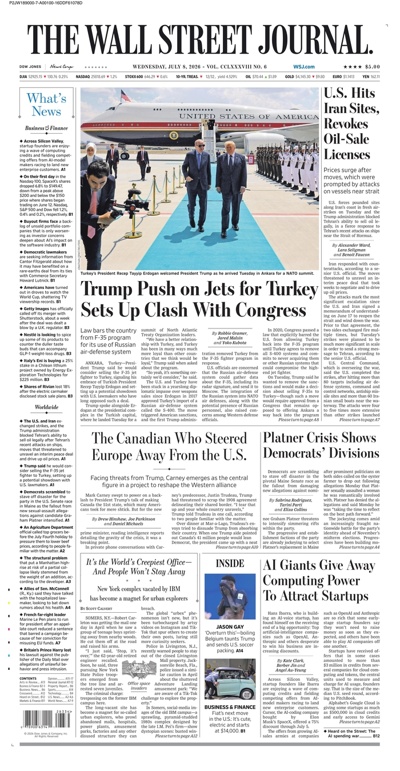
Wall Street Journal
“U.S. Hits Iran Sites, Revokes Oil-Sale Licenses”
— Wall Street Journal
Retaliatory strikes begin following attacks on commercial cargo ships in the Persian Gulf.
The narrative shifts from mourning to kinetic action. The Wall_Street_Journal links the military strikes directly to economic warfare, noting the revocation of oil-sale licenses. This suggests a multi-pronged 'maximum pressure' strategy being re-implemented in real-time.
Local papers like the Philadelphia_Inquirer and Arizona_Republic begin picking up the story as it moves from 'foreign news' to a 'national security crisis.' The Arizona_Republic introduces a specific finger-pointing angle, citing Qatari claims that Iran was responsible for the tanker strikes, providing the 'casus belli' that other papers were more vague about.
Notable angles
Arizona Republic — Specifically identifies Qatar as the source blaming Iran for the maritime attacks.
Where papers diverged
The Wall_Street_Journal focuses on the policy shift (oil licenses), while the Chicago_Tribune and Philadelphia_Inquirer focus on the physical strikes themselves.
Left out: Minimal coverage of the specific damage assessments from the U.S. strikes.
Also covered by 4 papers — click to enlarge
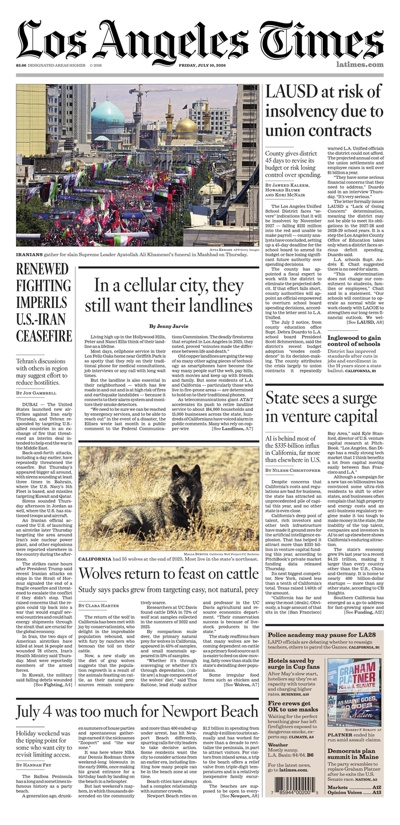
Los Angeles Times
“RENEWED FIGHTING IMPERILS U.S.-IRAN CEASEFIRE”
— Los Angeles Times
The total collapse of the ceasefire leads to intensifying fire across the Middle East.
This is the peak of the week's alarm. The Los_Angeles_Times uses all-caps to signal the peril to the ceasefire, while the Washington_Post details the expansion of strikes along the Iranian coast. The press is no longer questioning if there is a conflict, but how far it will spread.
The New_York_Times takes a more philosophical and cautionary tone, warning that 'Iran’s Hubris' could lead to a 'Bigger War.' This framing shifts the blame heavily toward Tehran's miscalculations rather than Washington's aggression. Meanwhile, the Wall_Street_Journal digs into the legalities, focusing on the specific 'clause' in the U.S.-Iran pact that is being used to justify the escalation.
Notable angles
New York Times — Frames the escalation as a result of Iranian 'hubris' and strategic miscalculation.
Wall Street Journal — Focuses on the legal/contractual breakdown of the U.S.-Iran pact.
Where papers diverged
The Minnesota_Star_Tribune and Tampa_Bay_Times provide more factual, wire-style updates, whereas the coastal giants (NYT, LAT, WaPo) offer deep strategic analysis and warnings of regional conflagration.
Left out: Almost no mention of the role of the United Nations or other international mediating bodies.
Also covered by 9 papers — click to enlarge
“Initial reporting on diplomatic friction transitioned into a war-footing narrative as the administration formally revoked the ceasefire by day four.”
Narrative Arc
The week began with mourning in Tehran and diplomatic unease, but shifted abruptly on July 8th as maritime attacks triggered U.S. retaliatory strikes. By mid-week, the framing moved from 'tensions' to an active 'end of ceasefire,' culminating in reports of direct assassination threats against the U.S. President.
Dropped It
Picked It Up
How Each Paper Evolved
Moved from mourning the Iranian leader to analyzing the economic and legal mechanics of the conflict's escalation.
Maintained a focus on the administration's tactical decisions and the intelligence-led threats to the President.
Adopted the most alarmist tone, culminating in a lead story about assassination threats.