
Paper Trail
US-Iran Military Escalation and the Strait of Hormuz
A volatile week of kinetic military exchanges between the US and Iran threatened to derail long-standing peace negotiations.
Wall Street Journal
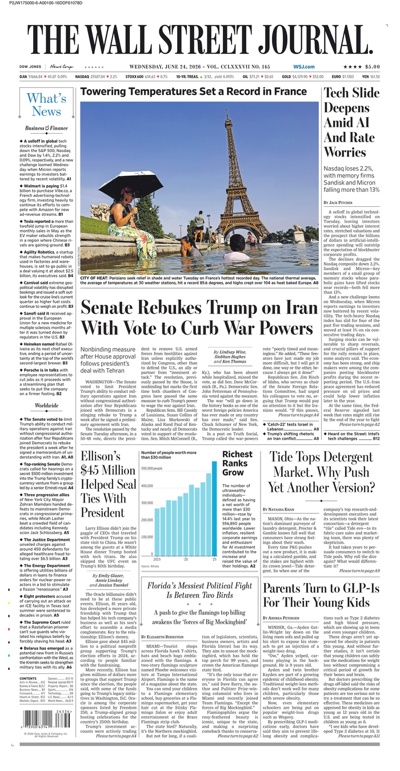
“Senate Rebukes Trump on Iran With Vote to Curb War Powers”
— Wall Street Journal
The US Senate asserting constitutional authority to prevent a full-scale war.
The initial coverage was heavily focused on the 'Senate Rebuke' of the President. The Wall_Street_Journal and Philadelphia_Inquirer framed this as an institutional clash, emphasizing the '10th try' to pass such a resolution.
There was a sense of legislative desperation in the coverage, suggesting that the press viewed the Senate as the last line of defense against an impulsive executive. The Chicago_Tribune was the only paper to link this directly to nuclear inspection disputes, providing a more technical geopolitical context than its peers.
Notable angles
Chicago Tribune — Focused specifically on the breakdown of nuclear inspections as the catalyst for the friction.
Where papers diverged
The Arizona_Republic took a more optimistic tone, highlighting Trump's claim that Iran had agreed to inspections, while the broadsheets focused on the Senate's lack of trust in that claim.
Left out: The specific vote count and the names of defecting party members were largely omitted.
Also covered by 6 papers — click to enlarge
Wall Street Journal
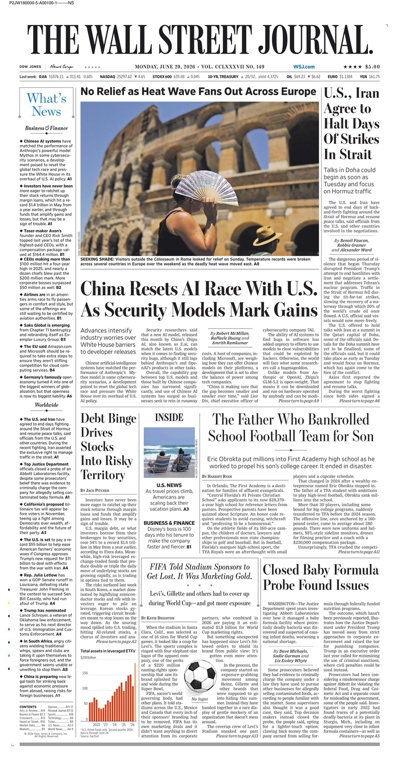
“U.S., Iran Agree to Halt Days Of Strikes In Strait”
— Wall Street Journal
A dangerous cycle of retaliatory strikes threatening global shipping and diplomacy.
The tone shifted dramatically to 'kinetic' reporting. The Philadelphia_Inquirer and Minnesota_Star_Tribune detailed strikes on Bahrain and Kuwait, moving the story from a bilateral US-Iran issue to a regional conflagration.
The Wall_Street_Journal attempted to find a 'diplomatic breakthrough' angle by reporting on the agreement to halt strikes, but the New_York_Times remained focused on the risk to the 'Shipping Revival.' This reveals a media split between those looking for an exit ramp and those documenting the structural damage to regional stability.
Notable angles
New York Times — Framed the conflict through its impact on the 'Shipping Revival,' prioritizing economic consequences.
Where papers diverged
The Wall_Street_Journal led with the 'Agreement to Halt,' while the Philadelphia_Inquirer led with the 'Attacks on Bahrain,' creating two very different impressions of the day's stability.
Left out: The impact on global oil prices was surprisingly absent from all front pages despite the proximity to the Strait of Hormuz.
Also covered by 8 papers — click to enlarge
“The narrative moved from a domestic constitutional debate about war powers to a high-stakes geopolitical crisis involving direct military counter-attacks.”
Narrative Arc
The story began with the US Senate attempting to curb war powers on day 1, but by day 4, the narrative shifted to active military strikes. The week ended with a fragile 'halt' to hostilities, though papers remained skeptical of the long-term truce.
Dropped It
Picked It Up
How Each Paper Evolved
Shifted from reporting on legislative constraints to reporting on active warfare and eventual fragile diplomacy.
Consistently focused on the risk to negotiations and inspections throughout the escalation.