
Paper Trail
Collapse of U.S.-Iran Ceasefire and Military Escalation
Retaliatory strikes between the U.S. and Iran escalated into a formal termination of the ceasefire following maritime attacks in the Persian Gulf.
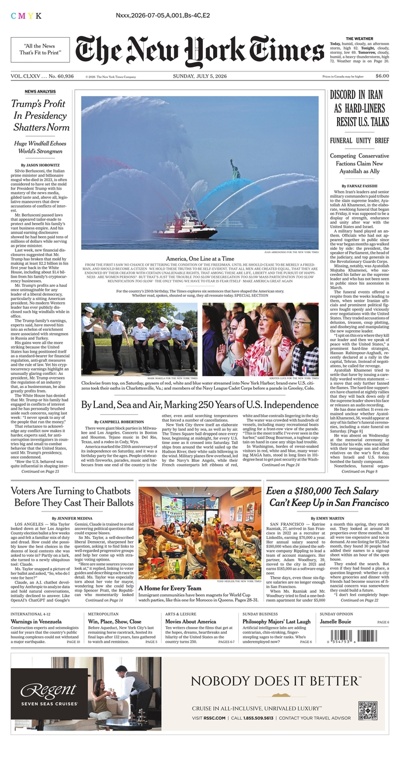
New York Times
“Discord in Iran as Hard-Liners Resist U.S. Talks”
— New York Times
Diplomatic friction as Iranian hard-liners resist potential talks with the U.S.
The New_York_Times provided early context on the internal power struggle in Tehran, framing the tension as a domestic political hurdle for Iranian moderates. At this stage, the coverage was cautious, treating the friction as a diplomatic stalemate rather than a precursor to kinetic conflict.
This early framing focused on the 'discord' within the Iranian regime, suggesting that the primary obstacle to peace was ideological rigidity in Tehran rather than imminent military action from Washington.
Left out: No mention of specific maritime threats or military readiness levels.
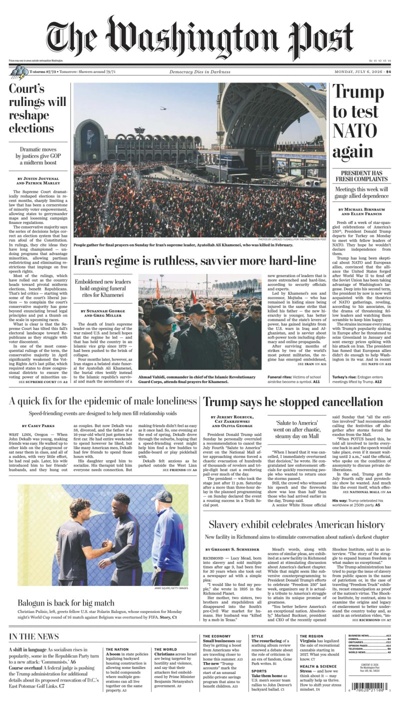
Washington Post
“Iran's regime is ruthless, savvier more hard-line”
— Washington Post
Mourning and regional tension following the death of a leader.
The tone shifted toward the human and symbolic elements of the conflict as the Wall_Street_Journal and Chicago_Tribune reported on mass mourning for a killed Iranian leader. The Washington_Post adopted a more analytical stance, warning that the regime was becoming 'savvier' and 'more hard-line' in the wake of the loss.
This day revealed a collective editorial focus on the 'savagery' of the regime, preparing readers for a more confrontational phase of the narrative. The papers began to link domestic Iranian mourning with broader geopolitical instability.
Notable angles
Washington Post — Focuses on the psychological and strategic evolution of the Iranian regime's leadership.
Where papers diverged
While the Journal and Tribune focused on the funeral and public mourning, the Post looked forward to the strategic hardening of the regime's stance.
Left out: Lack of clarity on the specific circumstances of the leader's death.
Also covered by 3 papers — click to enlarge
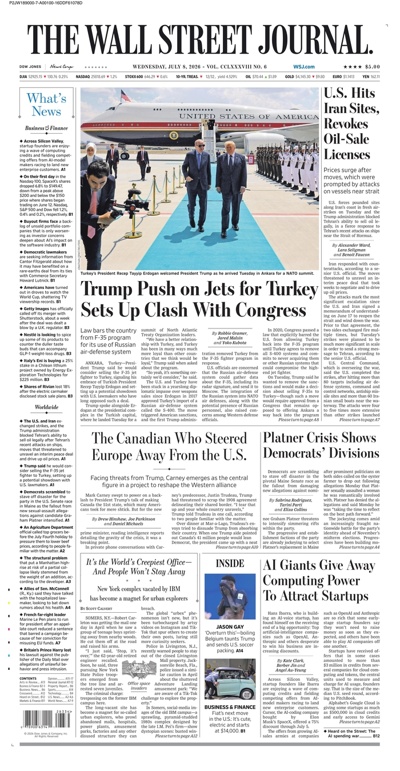
Wall Street Journal
“U.S. Hits Iran Sites, Revokes Oil-Sale Licenses”
— Wall Street Journal
Direct military retaliation following attacks on cargo ships.
The narrative transitioned from mourning to active warfare. The Wall_Street_Journal led with the revocation of oil licenses alongside military strikes, signaling a 'maximum pressure' hybrid approach. The Arizona_Republic introduced a regional dimension, citing Qatar's blame on Iran for tanker strikes.
This coverage reveals a shift in editorial priority toward the economic consequences of the conflict, specifically regarding oil and maritime security. The Philadelphia_Inquirer, however, kept the story below the fold, prioritizing local property values over the burgeoning Mideast war.
Notable angles
Arizona Republic — Highlights the role of Qatar in assigning blame for the maritime attacks.
Where papers diverged
The Wall_Street_Journal emphasized the economic sanctions (oil licenses), while the Chicago_Tribune and Inquirer focused purely on the kinetic strikes.
Left out: Minimal detail on the specific naval assets involved in the strikes.
Also covered by 4 papers — click to enlarge
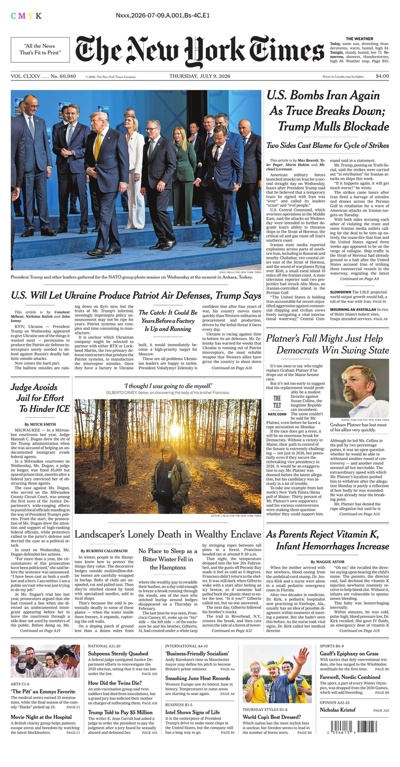
New York Times
“U.S. Bombs Iran Again As Truce Breaks Down; Trump Mulls Blockade”
— New York Times
The formal end of the ceasefire and the move toward a blockade.
This was the peak of the narrative's urgency. The New_York_Times introduced the possibility of a 'blockade,' a significant escalation in terminology. The New_York_Post used its characteristic punchy style with 'PEACE OUT,' signaling a total abandonment of diplomatic hope.
The collective coverage reveals an administration that has moved past 'retaliation' into a proactive military posture. Papers like the Minnesota_Star_Tribune and Arizona_Republic adopted high alarm scores (7), reflecting a consensus that the region was on the brink of a much larger conflict.
Notable angles
New York Post — Aggressive, simplified framing of the ceasefire collapse as a definitive break.
New York Times — Introduces the strategic concept of a naval blockade as the next escalatory step.
Where papers diverged
While most papers focused on the 'end' of the ceasefire, the New_York_Times was the only one to prominently discuss the 'blockade' as a specific policy option being considered.
Left out: No mention of the specific diplomatic terms of the now-defunct truce.
Also covered by 11 papers — click to enlarge
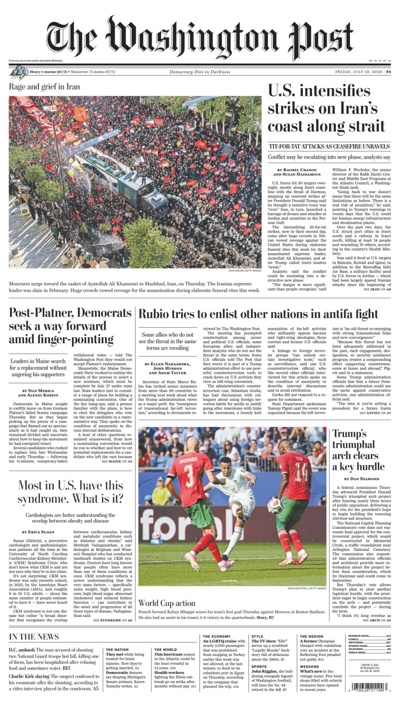
Washington Post
“U.S. intensifies strikes on Iran's coast along strait”
— Washington Post
Intensifying reciprocal strikes and the threat of regional war.
By the final day of the window, the framing shifted from the 'end of a truce' to the 'start of a war.' The Washington_Post focused on the geography of the strikes along the 'strait,' while the New_York_Times warned that 'Iran’s Hubris' could trigger a 'Bigger War.'
The editorial tone across the board became one of grim inevitability. The Minnesota_Star_Tribune provided the most tactical focus, highlighting the 'exchange' of attacks, which suggests a shift from U.S. dominance to a more balanced, dangerous conflict.
Notable angles
Wall Street Journal — Focuses on the legal technicalities of the 'Clause in U.S.-Iran Pact' at the center of the dispute.
Where papers diverged
The New_York_Times placed the blame on 'Iran's Hubris,' whereas the Los_Angeles_Times used more neutral language regarding 'Renewed Fighting.'
Left out: Lack of reporting on civilian casualty figures in the coastal strike zones.
Also covered by 9 papers — click to enlarge
“Initial diplomatic skepticism gave way to a dominant military framing as the White House officially declared the ceasefire 'over' by day 6.”
Narrative Arc
The story began as a secondary geopolitical concern regarding hard-liner resistance in Tehran before exploding into a front-page crisis by day 5. Initial reports of maritime friction rapidly transitioned into headlines about direct U.S. bombing campaigns and a total breakdown of diplomatic truces.
Picked It Up
How Each Paper Evolved
Moved from analyzing internal Iranian discord to warning of global war and blockades.
Consistent focus on the intersection of military action and economic/legal sanctions.
Shifted from psychological profiling of the regime to reporting on tactical coastal strikes.