
Paper Trail
Collapse of US-Iran Diplomacy into Military Strikes
A fragile diplomatic effort to resolve regional tensions collapsed into active military engagement and a constitutional clash over war powers.
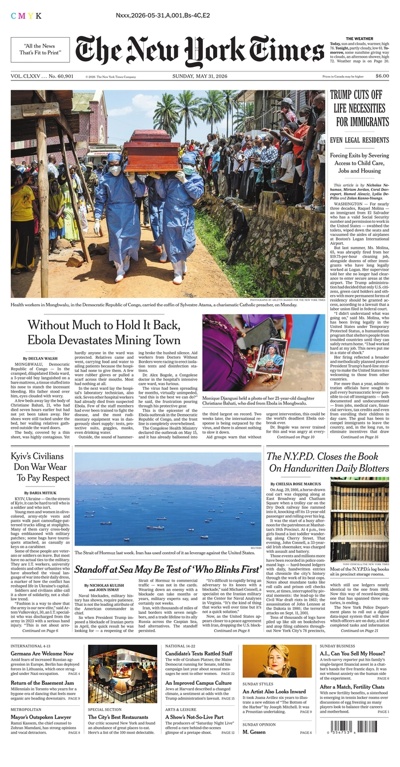
New York Times
“Standoff at Sea May Be Test of ‘Who Blinks First’”
— New York Times
Diplomatic tension is framed as a high-stakes game of chicken between global powers.
The New York Times sets a tone of calculated suspense with its 'Who Blinks First' framing, positioning the maritime standoff not just as a regional conflict, but as a test of international resolve. This choice suggests an editorial view that the situation is a psychological battle as much as a military one.
Meanwhile, the Chicago Tribune provides a more detached, wait-and-see approach, focusing on the 'war deal' as a pending decision. The collective coverage reveals a press corps that is wary of predicting escalation but deeply attuned to the fragility of the status quo.
Notable angles
New York Times — Focuses on the psychological 'blink' of the maritime standoff.
Where papers diverged
The New York Times emphasizes the immediate tactical tension at sea, while the Chicago Tribune frames the story through the lens of a pending political agreement.
Left out: Neither paper addresses the specific naval assets involved or the precise rules of engagement being followed.
Also covered by 2 papers — click to enlarge
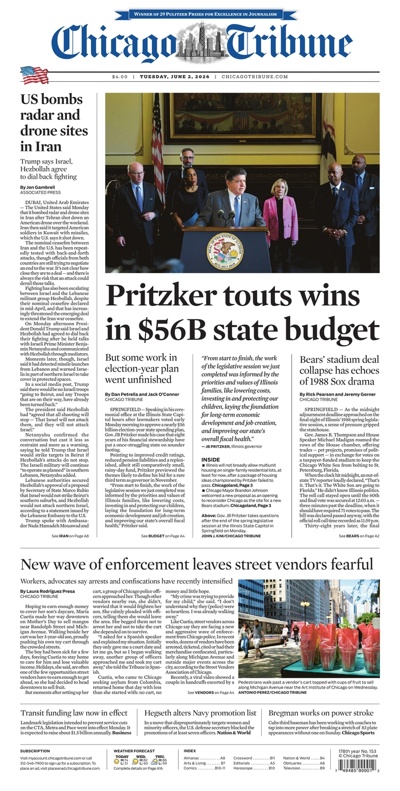
Chicago Tribune
“US bombs radar and drone sites in Iran”
— Chicago Tribune
Direct military escalation replaces diplomacy as the U.S. and Iran trade kinetic strikes.
The tone shifts dramatically today from 'standoff' to 'strikes.' The Chicago Tribune and Washington Post both report on U.S. bombing of Iranian radar and drone sites, signaling that the diplomatic window has effectively slammed shut. The language used—'trade strikes' and 'negotiations falter'—indicates a collective editorial consensus that the conflict has entered a new, more dangerous phase.
The Minnesota Star Tribune adds a layer of domestic political tension by noting the 'accusations' flying alongside the missiles. This suggests that the papers are beginning to look at the political fallout of the military action, even as the tactical details remain the primary focus.
Notable angles
Washington Post — Highlights the failure of the 'Board of Peace' in Gaza as a precursor to the strikes.
Where papers diverged
The Chicago Tribune is more direct about the military targets (radar and drone sites), while the Philadelphia Inquirer focuses on the 'shaky' nature of the ceasefire.
Left out: There is a notable lack of information regarding civilian casualties or the specific legal justification cited by the White House for the strikes.
Also covered by 5 papers — click to enlarge
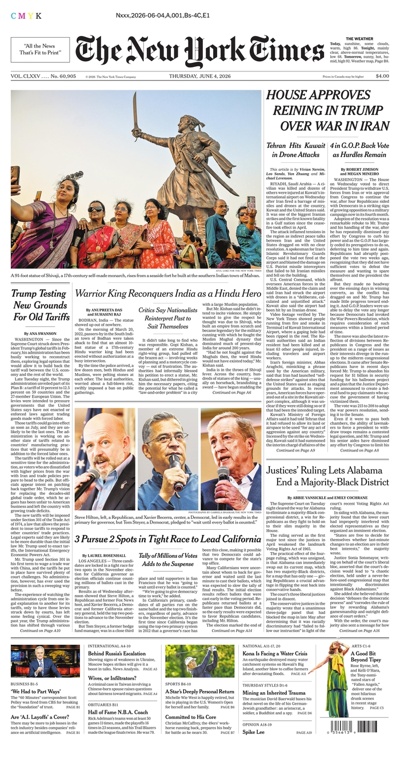
New York Times
“HOUSE APPROVES REINING IN TRUMP OVER WAR IN IRAN”
— New York Times
The conflict moves to the halls of Congress as a bipartisan rebuke of the President's war powers.
The story undergoes a major pivot today, moving from the Strait of Hormuz to the House floor. The New York Times uses the aggressive verb 'reining in' to describe the House resolution, framing it as a direct challenge to Trump's executive authority. This is a significant shift in tone, moving from reporting on a foreign war to reporting on a domestic constitutional struggle.
The Wall Street Journal reinforces this with the word 'rebuffs,' suggesting that the story is now primarily about the breakdown of the relationship between the executive and legislative branches. The collective coverage suggests that the press views this not just as a policy disagreement, but as a historic institutional confrontation.
Notable angles
New York Times — Elevates the story to a lead headline focused on reining in executive power.
Where papers diverged
The New York Times and WSJ treat this as a top-tier constitutional crisis, while the Chicago Tribune keeps it as a secondary item behind local mayoral news.
Left out: None of the papers provide a clear path for how this resolution passes the Senate or survives a certain Presidential veto.
Also covered by 3 papers — click to enlarge
“Initial diplomatic optimism gave way to military framing as strikes were reported, eventually settling on a domestic constitutional confrontation.”
Narrative Arc
The thread began with a tense diplomatic 'standoff at sea' that rapidly escalated into kinetic military strikes by day three. By the end of the week, the focus shifted from the battlefield to a domestic constitutional crisis as the House moved to strip the President of his war-making authority.
Picked It Up
How Each Paper Evolved
Moved from a psychological 'game of chicken' at sea to a high-stakes constitutional battle over war powers.
Maintained a reportorial focus on policy shifts and tactical strikes, treating the war powers resolution as secondary to local news.