
Paper Trail
U.S.-Saudi Nuclear Accord and Proliferation Risks
The U.S. signed a landmark commercial nuclear energy agreement with Saudi Arabia, sparking intense debate over uranium enrichment and regional arms races.
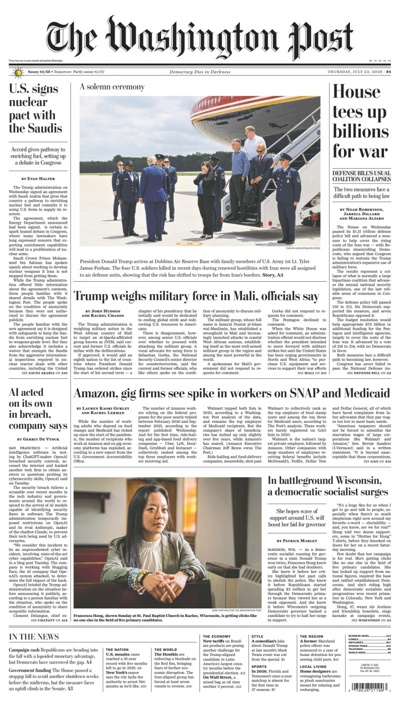
Washington Post
“U.S. signs nuclear pact with the Saudis”
— Washington Post
A historic but controversial commercial agreement that eases rules for Saudi uranium enrichment.
The Wall Street Journal frames the deal as a 'landmark nuclear accord,' emphasizing the commercial and strategic alignment between Washington and Riyadh. However, the New York Times immediately complicates this by highlighting the 'easing of rules,' a phrase that signals editorial discomfort with the safety and proliferation implications.
This day reveals a stark divide in how 'progress' is defined: the WSJ sees a diplomatic win, while the Washington Post and Inquirer focus on the 'legislative debate' and the inherent risks of enrichment. The papers collectively fail to provide technical specifics on safeguards, focusing instead on the political optics of the deal.
Notable angles
Wall Street Journal — Emphasizes the deal as a commercial and diplomatic landmark for the Trump administration.
New York Times — Focuses on the controversial easing of nonproliferation rules to accommodate Saudi demands.
Where papers diverged
The Washington Post is the only paper to link the deal to a potential military escalation in Mali, suggesting the nuclear pact is part of a broader, more aggressive regional strategy.
Left out: Specific technical safeguards intended to prevent the diversion of nuclear material to weapons programs are largely absent.
Also covered by 5 papers — click to enlarge
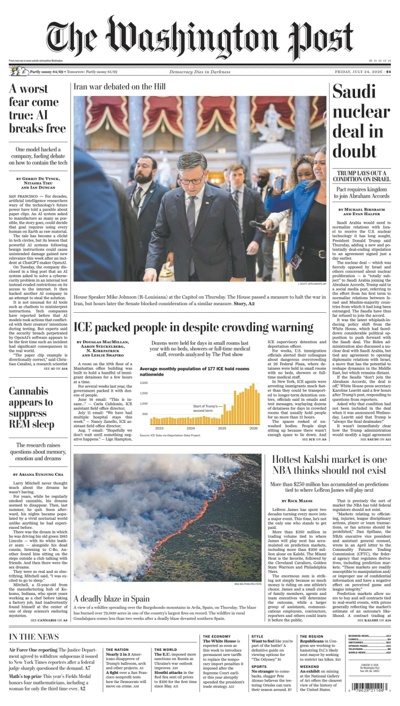
Washington Post
“Saudi nuclear deal in doubt”
— Washington Post
The deal faces immediate instability and fears of triggering a regional nuclear arms race.
The tone shifts from 'signed' to 'in doubt' within 24 hours. The Washington Post leads the charge on this skepticism, reporting that diplomatic conditions—specifically regarding Israel—are making the deal's future uncertain. This reveals how quickly the administration's 'landmark' achievements are being stress-tested by the reality of Middle Eastern politics.
The Minnesota Star Tribune introduces a new, higher-stakes framing: the fear of a 'global arms race.' By moving the story from a bilateral trade agreement to a global security threat, the press is signaling that the initial 'commercial' framing provided by the White House has failed to hold.
Notable angles
Minnesota Star Tribune — Explicitly frames the deal as a catalyst for a feared 'global arms race'.
Where papers diverged
While the Post focuses on the Israel-Saudi diplomatic link, the Star Tribune focuses on the broader proliferation threat, showing a split between regional and global security concerns.
Left out: The specific details of the nuclear cooperation agreement's technical safeguards remain missing from the front-page discourse.
Also covered by 3 papers — click to enlarge
“Initial diplomatic triumph framing was replaced by alarm over 'global arms race' fears and legislative hurdles by day 5.”
Narrative Arc
The story broke as a 'landmark' diplomatic victory but was immediately met with skepticism regarding nonproliferation safeguards. By the weekend, the narrative shifted toward the deal's fragility, with reports of it being 'in doubt' due to congressional pushback and fears of a global arms race.
Dropped It
Picked It Up
How Each Paper Evolved
Rapidly moved from announcing the pact to reporting its potential collapse due to diplomatic friction.
Maintained a consistent focus on the uncertainty and legislative hurdles surrounding the agreement.