
Paper Trail
Venezuelan Earthquake Crisis and Geopolitical Relief Standoff
Two massive earthquakes in Venezuela triggered a humanitarian disaster that quickly evolved into a political battleground over international aid and government transparency.
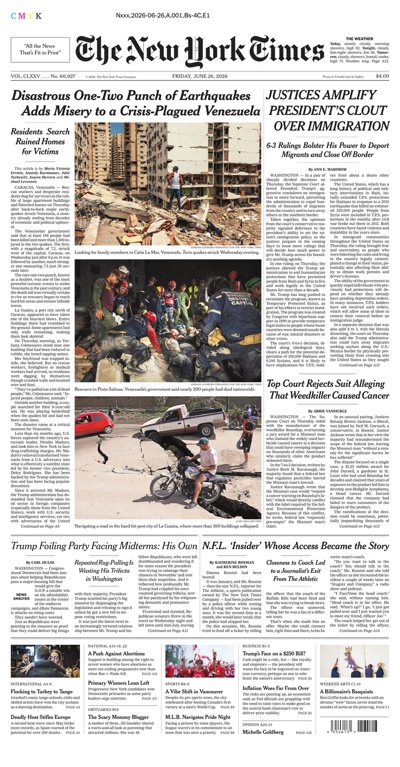
New York Times
“Disastrous One-Two Punch of Earthquakes Adds Misery to a Crisis-Plagued Venezuela”
— New York Times
A catastrophic humanitarian emergency requiring immediate global attention.
The press reacted with visceral urgency to the 'one-two punch' of the quakes. The New York Times and Los_Angeles_Times led with the human tragedy, using evocative language like 'misery' and 'devastating toll' to frame the event as a test of global empathy.
In contrast, the Wall_Street_Journal took a more detached, analytical stance, placing the story lower on the page and focusing on the shock to the Venezuelan state rather than the individual suffering. This day revealed a clear divide between papers treating the event as a moral imperative versus those viewing it as a regional instability factor.
Notable angles
Los Angeles Times — Explicitly linked the Venezuelan disaster to California's own seismic risks to create local relevance.
Where papers diverged
While most papers focused on the search for survivors, the Wall_Street_Journal was notably less 'alarmed,' framing the event as an 'Other' category story rather than a primary humanitarian crisis.
Left out: Almost no mention of specific international aid figures or the role of the UN in the immediate aftermath.
Also covered by 8 papers — click to enlarge
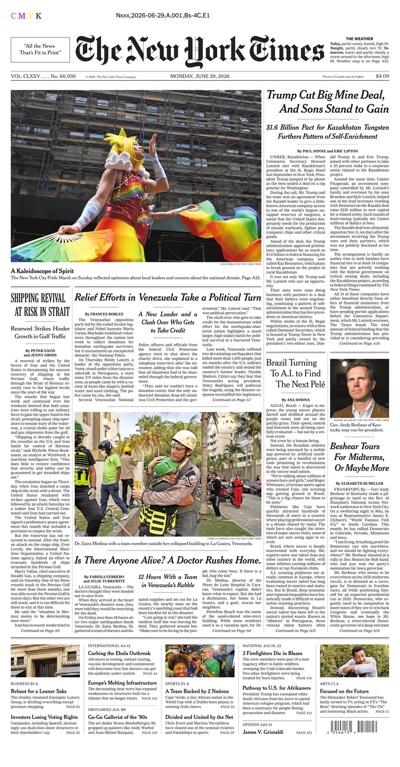
New York Times
“Relief Efforts in Venezuela Take a Political Turn”
— New York Times
The transition from rescue operations to political accusations regarding aid distribution.
By the 29th, the narrative had soured. The New_York_Times and Philadelphia_Inquirer both moved away from the rubble to the presidential palace, reporting on allegations that the Venezuelan government was politicizing the relief effort.
This shift suggests a cynical turn in the media cycle: the 'miracle rescue' stories were replaced by the 'corrupt regime' trope. The coverage reveals a media consensus that the disaster cannot be viewed in isolation from Venezuela's existing political fractures.
Notable angles
Philadelphia Inquirer — Directly accused the government of politicizing relief, using more aggressive language than the broadsheets.
Left out: The specific status of the UK rescue team mentioned in earlier briefs was entirely dropped from front-page coverage.
Also covered by 2 papers — click to enlarge
“Initial coverage focused on the raw human toll of the 'one-two punch' before pivoting to the logistical and political friction of international intervention by day 5.”
Narrative Arc
The story began as a pure humanitarian tragedy with high alarm scores across all papers. By mid-week, the focus shifted from rescue efforts to the politicization of aid, as papers like the New York Times and Philadelphia Inquirer highlighted accusations that the Venezuelan government was weaponizing relief for political leverage.
Dropped It
How Each Paper Evolved
Moved from humanitarian empathy to a critical analysis of political exploitation of the crisis.
Maintained high alarm throughout, transitioning from death toll tracking to political accountability.