
Paper Trail
US-Iran Peace Negotiations and Military Escalation
A fragile diplomatic framework between the US and Iran disintegrated over seven days, shifting from a tentative ceasefire to active military strikes and a legislative rebuke of presidential war powers.

Washington Post
“U.S. and Iran reach a loose framework to end Mideast war”
— Washington Post
Cautious reporting on a 'tentative' and 'loose' framework for a ceasefire and diplomatic resolution.
The Washington Post leads with a sense of historical breakthrough, framing the 'loose framework' as a major victory for diplomacy, while regional outlets like the Tampa_Bay_Times and Philadelphia_Inquirer are more measured, positioning it as a secondary, 'tentative' extension of an existing ceasefire.
This early coverage reveals a significant gap between the high-level diplomatic narrative in D.C. and the more skeptical, wait-and-see approach of regional papers, which focus on the instability of the pact rather than its potential for lasting peace.
Notable angles
Houston Chronicle — Explicitly notes that Trump has yet to officially authorize the pact, highlighting executive hesitation.
Where papers diverged
The Washington Post treats the framework as a top-tier national achievement, whereas the New_York_Times ignores the 'breakthrough' on its front page, focusing instead on the pulverized reality of Lebanon.
Left out: Detailed technical analysis of the proposed sanctions relief mechanisms.
Also covered by 5 papers — click to enlarge
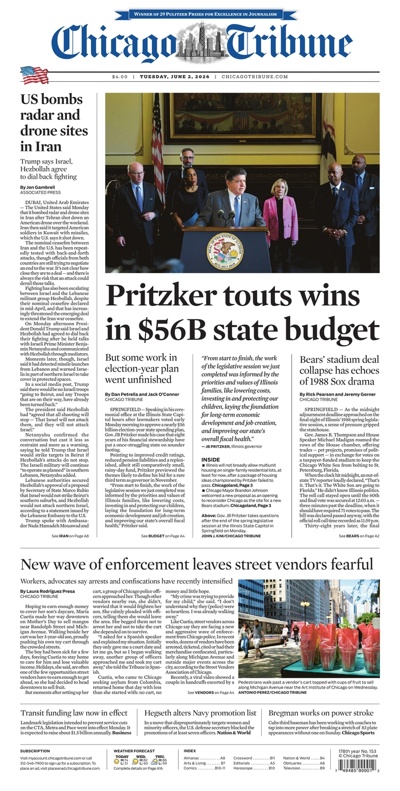
Chicago Tribune
“US bombs radar and drone sites in Iran”
— Chicago Tribune
Diplomatic stagnation yields to military escalation as both nations exchange strikes.
The tone shifts sharply from negotiation to confrontation. The New_York_Times takes a cynical view, noting that 'Trump’s Talk Meets Reality' in the face of regional stalemates. Meanwhile, the Chicago_Tribune and Washington_Post report on direct US strikes against Iranian radar and drone sites, signaling the collapse of the earlier 'loose framework.'
The collective coverage suggests a transition from a 'peace' story to a 'war' story. The focus is no longer on what might be signed, but on who is striking where, with the Philadelphia_Inquirer explicitly calling the ceasefire 'shaky.'
Notable angles
New York Times — Focuses on the collapse of Lebanese efforts to disarm Hezbollah as a side effect of the failed diplomacy.
Arizona Republic — Directly blames Israeli raids on Lebanon for Iran's decision to suspend talks.
Where papers diverged
The Wall_Street_Journal highlights Trump's continued desire to 'seek an end' to the conflict, while the Chicago_Tribune and Minnesota_Star_Tribune focus on the active exchange of 'attacks and accusations.'
Left out: Depth on the internal Iranian leadership debate regarding whether to continue engagement despite the strikes.
Also covered by 9 papers — click to enlarge
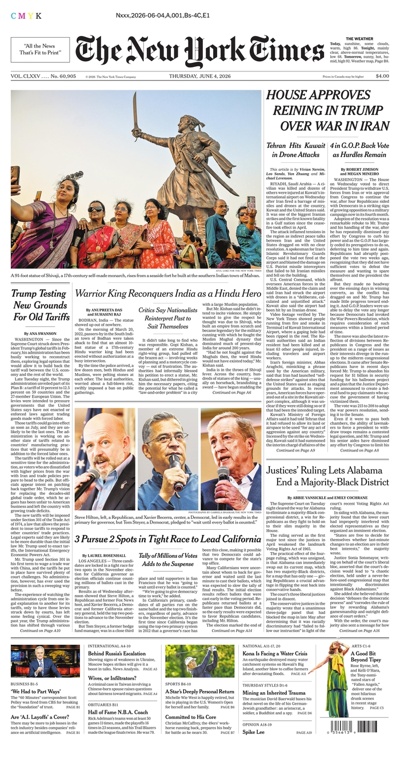
New York Times
“HOUSE APPROVES REINING IN TRUMP OVER WAR IN IRAN”
— New York Times
The legislative branch asserts control as the House votes to limit the President's war-making powers.
The narrative concludes not in the Middle East, but in the halls of Congress. The New_York_Times uses a high-alarm headline ('REINING IN TRUMP') to frame the House resolution as a historic rebuke. This represents a total shift in the week's story arc: the crisis has moved from an external diplomatic challenge to an internal constitutional one.
The Wall_Street_Journal emphasizes the bipartisan nature of the 'rebuff,' suggesting that the administration's 'zigzagging' strategy (reported earlier in the week) has finally exhausted congressional patience. The Arizona_Republic, however, offers a dissenting note, reporting Trump's claim that Iran has agreed to 'no nukes for now,' a possible attempt at face-saving narrative control.
Notable angles
Arizona Republic — Provides a platform for Trump's claim of a nuclear concession, contrasting with the 'rebuke' narrative elsewhere.
Where papers diverged
While the NYT and WSJ focus on the constitutional clash, the Chicago_Tribune relegates the House vote to a secondary item, choosing to lead with local mayoral politics.
Left out: Analysis of the resolution's chances in the Senate or its practical enforceability.
Also covered by 5 papers — click to enlarge
“Initial diplomatic optimism gave way to a focus on military escalation and constitutional crisis as peace talks collapsed into tit-for-tat strikes.”
Narrative Arc
The thread began with cautious optimism as papers reported a 'loose framework' for peace, but coverage quickly pivoted to administrative 'zigzagging' and stalled talks. By mid-week, the narrative shifted from diplomacy to direct military engagement, culminating in a major constitutional clash as the House moved to rein in executive authority.
Dropped It
Picked It Up
How Each Paper Evolved
Moved from optimistic reporting on a peace framework to detailing military drone strategies and administrative obstacles.
Consistent skepticism, evolving from 'zigzagging' critiques to a focus on the constitutional battle over war powers.
Traced the internal party 'bind' for Trump, eventually highlighting his claims of success despite the legislative pushback.
Full Arc
This story extends beyond the 7-day Paper Trail window.
See the full 12-day arc →